

I Ordered an ₹800 “Natural Ruby” Online. Here’s What Arrived.
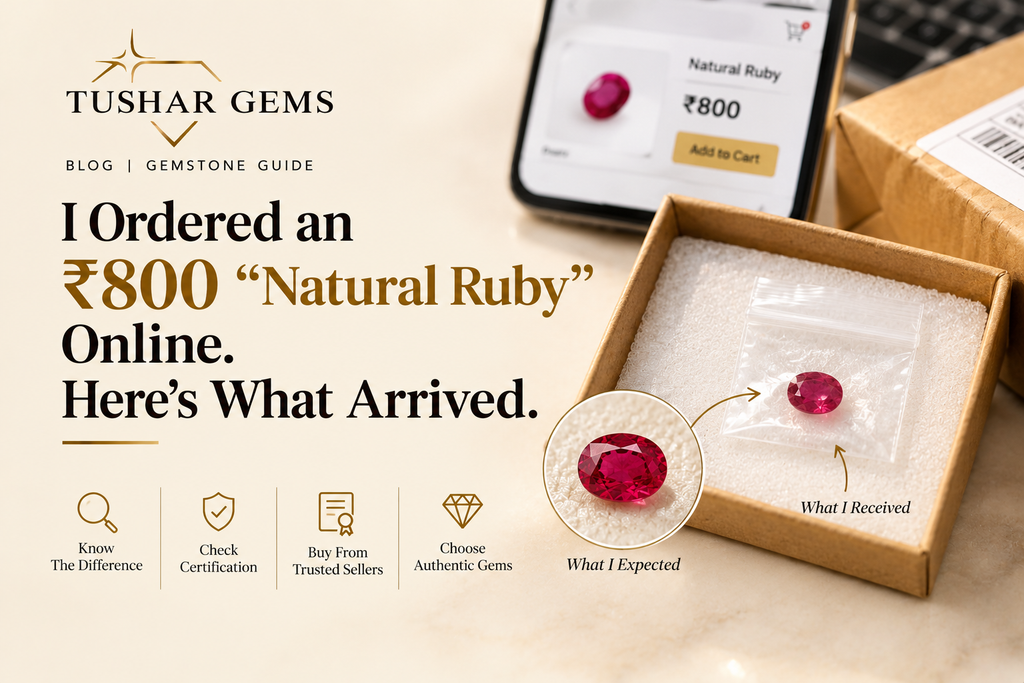
While browsing a large online marketplace, our founder Ravi Kapoor kept seeing the same kind of listing: “Natural Ruby”, “Natural Yellow Sapphire”, “Natural Blue Sapphire”, each priced at around ₹800, many with a “certificate included”.
After 28 years in the gemstone trade, he knew what to expect. But he wanted to see it for himself. So he placed an order.
He spoke about what arrived in his interview on Kuch Ankaha with Yashika (Daily Diary News):
- The “natural ruby” was a piece of glass.
- It was set in an alloy metal ring worth roughly ₹20.
- And it came with a certificate, which was fake.
Do the maths on an ₹800 ruby
Think about what has to be paid for before a stone reaches your door:
- The marketplace’s commission, which can be a large share of the sale price
- Shipping and packaging
- The cost of a genuine lab certificate
- The seller’s own margin
Now add the stone itself.
A natural ruby is formed over thousands of years deep inside the earth, under heat, pressure and a particular mix of minerals. It is then mined, often in Myanmar (Burma), Mozambique or other distant sources. It is traded, imported into India, cut and polished, and only then set and sold.
As Ravi Kapoor asked in the interview:
“After thousands of years in the earth and this long journey, the stone reaches you for ₹800? Do you believe that? I don’t think you should.”
A marketplace is a platform, not a guarantee
Large marketplaces let thousands of independent sellers list products. A listing on a well-known website does not mean the website has tested the gemstone. The seller writes the title, uploads the photo and attaches whatever “certificate” they like.
That is why the question is never just where you buy, but who you buy from.
Fake certificates are easy to print
A piece of paper with a logo, a stamp and the word “Natural” costs almost nothing to produce. A real certificate is different because you can check it independently:
- It comes from a recognised lab with a public website.
- It carries a report number you can look up on that website.
- The lab’s online record shows the same weight, measurements and photo as the stone you received.
If you cannot verify the report number on the lab’s own website, treat the certificate as decoration. Read How to Read a Gemstone Certificate and our list of 7 Signs of a Fake Gemstone.
What if your budget is small?
A low budget is not a problem. Buying glass is.
In Vedic tradition, most major gemstones have an uparatna, a natural substitute that costs far less:
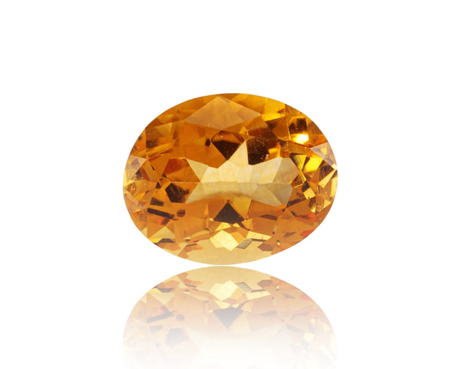
- Citrine (Sunela) for Yellow Sapphire (Pukhraj)
- Iolite (Kaka Neeli) for Blue Sapphire (Neelam)
- Garnet for Ruby (Manik)
Ravi Kapoor’s view is that a natural uparatna may take longer to show its effect, often three to six months, but it is still a natural stone. A glass piece is not. Read more in our Uparatna guide.
How to buy a gemstone online safely
- Check the seller first. How long have they been in the trade? Do they have a physical store you can visit? A GST-registered company name?
- Ask for the certificate before you pay. Verify the report number on the lab’s website yourself.
- Prefer recognised labs. We recommend IIGJ Research & Laboratories, which works under GJEPC.
- Be suspicious of prices that look too good. “Natural ruby for ₹800” is not a deal. It is a warning.
- Ask about returns in writing before you order.
How Tushar Gems sells online
Every natural gemstone on tushargems.com is listed with its lab report details, and IIGJ-certified stones are clearly marked. The stone in the photo is the stone you receive. You can verify the certificate before you buy, and if you live outside Delhi NCR, our team can show you the stone live on a video call.
Read also: ₹65,000 for a Yellow Sapphire That Was a ₹1,500 Citrine.
Natural gemstones are not cheap, and they should not be. But they should always come with proof.
Watch the full conversation: Kuch Ankaha with Yashika, featuring Ravi Kapoor.
Related guides from Tushar Gems
-
Posted in
certification, fake gemstones, manik, online buying, ruby