
How to Read a Gemstone Certificate (Line by Line)
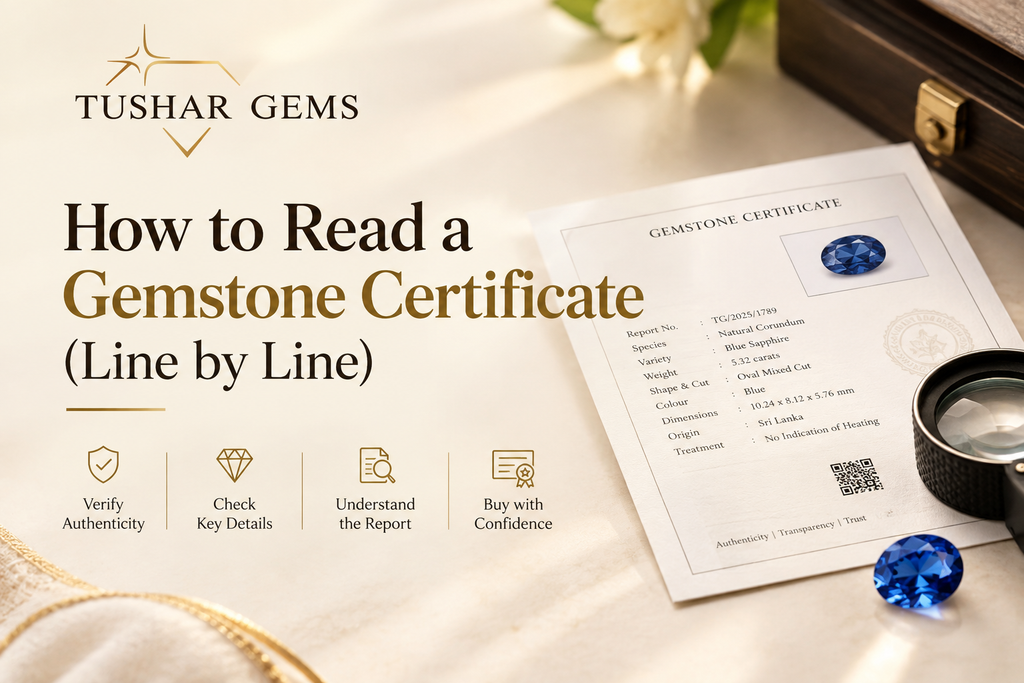
Published by Tushar Gems & Jewellery Pvt. Ltd. — Gurugram | Natural · Certified · Trusted | Since 1998
Every honest gemstone article ends with the same advice: always ask for a certificate.
Almost none of them tell you what to do with it once it is in your hand. So most buyers glance at the letterhead, see the stone's name, and file the paper away. That is a shame, because the certificate is the only part of the purchase that is not a matter of opinion. The seller's description can be enthusiastic. The report is just measurements.
Here is how to read one, field by field — and what should make you pause.
First: certificate, appraisal, and guarantee card are three different things
| Document | What it actually tells you |
|---|---|
| Laboratory certificate / report | What the stone is: species, natural or synthetic, treatments, weight, measurements |
| Valuation or appraisal | Someone's estimate of monetary value — an opinion, often for insurance |
| Shop guarantee or warranty card | The seller's own promise, printed by the seller |
Only the first is independent evidence. A shop card with a photo and a stamp is not a laboratory report, however impressive it looks. If a seller offers you a “certificate” printed on their own letterhead, you have been given a receipt with ambitions.
Why a certificate is worth insisting on
- Resale value: a certified stone is much easier to sell or upgrade in the future.
- Insurance accuracy: insurers rely on an official report to value your jewellery correctly.
- Peace of mind: you know exactly what you are paying for, with no hidden surprises about treatment or origin.
Which laboratories to trust
In India, IIGJ and GII are the labs most commonly seen for astrological stones — every stone we sell at Tushar Gems is IIGJ certified. GIA and IGI are the international names you will encounter most often, particularly for diamonds. At the top of the market, Swiss labs like SSEF and Gübelin issue the origin reports that fine coloured stones trade on.
What matters is not collecting the most famous name on the list, but that the lab is independent of the seller, has a verifiable report number, and states treatments explicitly.
Be wary of a “lab” you cannot find online, a report with no unique number, or a laboratory that happens to operate from the same address as the shop.
The report, field by field
Report number and date. Every genuine report carries a unique number. It should also be verifiable on the laboratory's website. A report older than a few years is not invalid, but it belongs to the stone, not the seller — make sure the number on the paper matches the stone you are being handed.
Shape and cut. Descriptive: oval mixed cut, cushion, emerald cut, round brilliant. This is the easiest field to cross-check against the stone in front of you. A well-proportioned cut returns light evenly; a poor cut can make a high-quality stone look dull.
Measurements (mm). Length × width × depth. This is your protection against a swapped stone: measurements are a fingerprint. If the paper says 9.12 × 7.04 × 4.86 mm, the stone in the ring should measure that. Depth also matters — two stones can look the same size from the top while one is bottom-heavy, which changes how it sits in a setting and its price per carat.
Weight (carat). The international unit — 1 carat = 0.20 g. Indian sellers often quote in ratti; convert before you compare (1 ratti ≈ 0.91 carat).
Colour. A descriptive grade — blue, greenish blue, medium dark. Coloured stones do not have a universal colour grading scale the way diamonds do, so this field is a description, not a score. A detailed report describes hue (the colour itself), tone (how light or dark) and saturation (intensity); trade terms like “Royal Blue” or “Pigeon Blood Red” are used for premium material.
Transparency and lustre. Transparent, translucent, opaque. For an astrological stone, transparent is what you are usually looking for.
Refractive index (RI) and specific gravity (SG). These are the tests that identify the mineral. They are the reason a certificate can tell topaz from sapphire when your eye cannot.
| Stone | Typical RI | Typical SG |
|---|---|---|
| Sapphire / Ruby (corundum) | 1.762 – 1.770 | 3.95 – 4.05 |
| Emerald (beryl) | 1.577 – 1.583 | 2.67 – 2.78 |
| Topaz | 1.609 – 1.643 | 3.49 – 3.57 |
| Citrine (quartz) | 1.544 – 1.553 | ~2.65 |
You do not need to memorise these. You only need to know that if the mineral name says corundum, the numbers should sit in the corundum range.
Species and variety. This is the most important line on the page. It should read something like natural corundum, variety blue sapphire. Three words to look for:
- Natural — formed in the earth, not grown in a lab
- The species — corundum, beryl, quartz, topaz, garnet
- The variety — blue sapphire, emerald, citrine, or for garnet, tsavorite vs rhodolite
If the word “synthetic” or “lab-grown” appears, you are holding a laboratory-created stone. It may be beautiful and it is honestly sold when labelled — but tradition does not accept it for astrological wear.
Clarity and inclusions. Many reports note inclusions. In coloured stones “eye-clean” is the benchmark, but some inclusions — like the fine “silk” in rubies and sapphires — actually help prove natural origin.
Comments / treatment. The line most buyers skip and the one that moves the price most. Look for wording such as no indications of heating (untreated) versus indications of heating, fracture filled, oiled, diffusion treated, irradiated or dyed. Heat is widely accepted in jewellery for sapphires and rubies, and oiling is standard for emeralds; diffusion and irradiation are more aggressive and lower value sharply.
An empty comments field is not the same as “untreated”. If treatment status matters to you — and for astrological use it should — the report must say so in words. Ask for a report that addresses it explicitly rather than one that stays silent.
Origin. Ceylon, Zambian, Colombian, Burmese. Note that origin determination is a specialist service and often comes as a separate report or an additional line, not as standard. If origin is being used to justify the price, it must be on paper.
Photograph and QR code. Most modern reports carry both. Scan the code, or type the report number into the lab's website, and check that what appears on screen matches the paper in your hand.
Red flags worth walking away from
- The certificate is on the shop's own letterhead
- No unique report number, or a number that does not verify online
- Measurements that do not match the stone you are being shown
- The treatment line is blank, vague, or “not tested”
- The word “natural” is missing from the species line
- Origin is claimed verbally but appears nowhere on paper
- A valuation figure printed on the report itself — labs identify stones, they do not price them
For astrological buyers, four lines matter most
If you read nothing else on the page, read these:
- Species and variety — is it the stone you were promised?
- Natural — not synthetic, not simulant
- Treatment — untreated is what tradition prescribes
- Weight — matches what your astrologer advised, in the unit you think it does
Everything else is useful. These four decide whether the stone does the job you bought it for.
Frequently asked questions
Does a certificate guarantee the stone's value?
No. A laboratory report identifies the stone. It does not price it. Price comes from colour, clarity, origin, treatment, size and the market — which is why two certified stones of the same weight can differ enormously.
My certificate is old. Is it still valid?
The stone has not changed, so the identification stands. But confirm that the measurements and weight on the report match the stone you are actually buying.
Can certificates be faked?
Yes, which is why the verification step matters. Check the report number on the laboratory's own website rather than trusting the paper alone.
Should I re-certify a stone I already own?
If you bought without a report, or the report cannot be verified, an independent test is worth the modest cost — particularly before an expensive re-setting.
Does a certificate say whether the stone suits my chart?
No. That is astrology, not gemmology. The report tells you what the stone is; your kundli decides whether you should wear it.
Bring us the paper, we will read it with you
If you already own a stone and are unsure what the report says, bring both in. We will walk through it line by line — no obligation to buy anything. And every stone we sell leaves the store IIGJ certified, with the treatment status stated in writing.
Tushar Gems & Jewellery Pvt. Ltd.
19–20, Second Floor, Sushant Lok-1, Gold Souk Mall, Gurugram, Haryana 122003
+91 95400 05348 · tushargems2026@gmail.com
tushargems.com
Your Gems, Your Destiny.
Disclaimer: Gemstone recommendations described in this article are based on traditional Vedic astrology and are shared for informational purposes. They are not a substitute for medical, financial or legal advice.
-
Posted in
buying guide, certified gemstones, gemstone certificate, IIGJ
)