

Italian Coral vs Japanese Coral: Moonga Ratna Guide
Tushar Gems & Jewellery Pvt. Ltd. — Gurugram & Delhi | Natural · Certified · Trusted | Since 1998
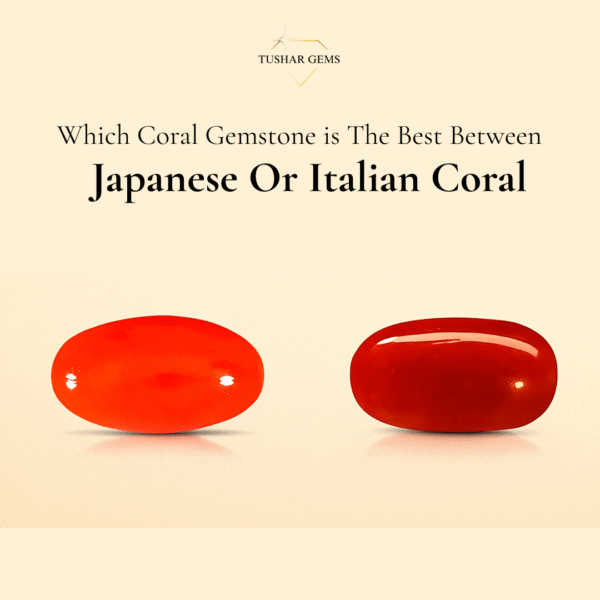
Walk into any gemstone shop and ask for Moonga, and the first question you will hear back is: Italian or Japanese? Both are natural red coral, both are worn for Mangal, and both come with a certificate. Yet they look different, they are priced differently, and people often buy one when the other would have suited them better.
Here is the plain comparison, so you can make that choice yourself.
What coral actually is
Red coral is not a mineral. It is an organic gem, built up over many years by tiny marine animals (coral polyps) as a branching calcium-carbonate skeleton. That is why coral is softer than most gemstones, why it reacts to acids and perfume, and why it is sold as cabochons and beads rather than faceted stones.
In Vedic astrology, Moonga is the stone of Mangal (Mars), traditionally linked with courage, energy and drive. It is suggested for Mesh (Aries) and Vrishchik (Scorpio), and is the remedy most often discussed for Mangal dosha — always after the birth chart has been read.
Italian vs Japanese coral at a glance
| Italian coral | Japanese coral | |
|---|---|---|
| Where it comes from | Mediterranean Sea | Pacific waters around Japan and Taiwan |
| Colour | Orange-red to bright red | Deeper red, up to the dark "ox-blood" shade |
| Texture | Fine, even, smooth polish | Dense; often shows a faint white core or growth lines |
| Availability | The most common astrological Moonga | Scarcer, especially in deep red |
| Price | Usually the more affordable of the two | Usually costs more per ratti |
Which one should you choose?
Tradition does not say that one origin is "more powerful" than the other. What matters for astrological wear is that the coral is natural and undyed, of the prescribed weight, and set so that it touches the skin. Within that, the choice is mostly about colour preference and budget:
- Choose Italian if you want a clean, even orange-red stone at a reasonable price per ratti. It is what most astrologers have in mind when they say "Moonga".
- Choose Japanese if you prefer a deep blood-red colour and the budget allows. Make sure the deep colour is natural, not dyed.
How to check the coral before you pay
- Look for growth lines. Natural coral shows fine wood-grain-like lines and tiny pits. Plastic, glass and "reconstructed" coral look unnaturally even.
- Rub it on a white cloth. If colour comes off, the stone is dyed.
- Read the origin on the report. If you are paying a Japanese-coral price, the certificate should support it.
- Check the weight in ratti. Coral is usually prescribed by ratti, and the common rule is about one ratti for every 10 kg of body weight — your chart decides the final number.
How Moonga is traditionally worn
- Day: Tuesday morning, after sunrise
- Finger: ring finger of the working hand
- Metal: copper, gold or panchdhatu
- Mantra: Om Kraam Kreem Kraum Sah Bhaumaya Namah, 108 times
- Setting: open-back, so the coral touches the skin
Caring for coral
Because coral is soft and organic, keep it away from perfume, hair spray, soap and household cleaners. Wipe it with a soft damp cloth, never use an ultrasonic cleaner, and take the ring off for the gym or heavy housework.
Frequently asked questions
Is Japanese coral better for astrology than Italian?
No tradition ranks one origin above the other for astrological effect. Natural, undyed coral of the right weight is what matters.
Why is Japanese coral more expensive?
Deep red material is scarcer, and the darker colours are in demand for jewellery as well as astrology.
Can I wear coral with Pukhraj or Moti?
Moonga is traditionally considered compatible with Manik, Moti and Pukhraj, but ask your astrologer to check your own chart first.
Related reading from Gemstone Gyaan
- Red Coral (Moonga): for Mangal dosha and courage
- How to identify original red coral
- Heated, treated, filled: gemstone treatments explained
Tushar Gems & Jewellery Pvt. Ltd.
Gurugram: Shop No. 19–20, 2nd Floor, Gold Souk Mall, Sushant Lok 1, Sector 43, Gurugram, Haryana 122009 — open all seven days, 11 AM–8 PM
Delhi: 36/3092 Beadon Pura, Karol Bagh, New Delhi 110005 — Tuesday to Sunday, 11 AM–8 PM
Phone & WhatsApp: +91 95400 05349 · tushargems2026@gmail.com
Disclaimer: Gemstone recommendations described in this article are based on traditional Vedic astrology and are shared for informational purposes. They are not a substitute for medical, financial or legal advice.


