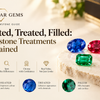
Heated, Treated, Filled: Gemstone Treatments Explained

Published by Tushar Gems & Jewellery Pvt. Ltd. — Gurugram & Delhi | Natural · Certified · Trusted | Since 1998
Here is a sentence that surprises most first-time buyers: a treated gemstone is not a fake gemstone.
A heated sapphire is still a sapphire. An oiled emerald is still an emerald. Treatments are a normal, long-established part of the jewellery trade, and most coloured stones in the world market have been treated in some way.
The problem is never the treatment itself. The problem is a treatment that is not disclosed — and, for astrological buyers, a treatment on a stone that tradition expects to be natural and untreated. Here is what each one is.
The main treatments, in plain language
| Treatment | Commonly found on | What it does | Permanent? |
|---|---|---|---|
| Heating | Sapphire, ruby | Improves colour and clarity by heating the stone to high temperatures | Yes |
| Oiling / resin filling | Emerald | Fills surface-reaching fractures so they become less visible | No — can dry out or seep over years |
| Lead-glass filling | Ruby, some sapphire | Fills heavy fractures with glass; creates a composite stone | Fragile — damaged by heat and acids |
| Diffusion (surface or beryllium) | Sapphire | Adds colour from outside the stone during heating | Colour may be shallow; re-cutting can remove it |
| Dyeing | Coral, pearl, onyx, quartz, jade | Adds colour that is not natural to the stone | Often fades |
| Irradiation | Topaz, some quartz | Changes colour — most blue topaz is produced this way | Usually stable |
| Bleaching | Pearl | Lightens and evens the colour | Yes |
Acceptable in jewellery, a question in astrology
For a necklace, earrings or a fashion ring, a disclosed treatment is simply part of the stone's description. You get a beautiful gem at a lower price, and there is nothing wrong with that.
For a gemstone worn to strengthen a planet, Vedic tradition asks for natural and untreated. That is the standard we apply at Tushar Gems for astrological stones, and it is the standard we recommend you ask for, wherever you buy.
Between those two worlds sits the real risk: a treated stone sold at an untreated price, or sold for astrological use without a word said.
How treatment changes the price
The difference can be enormous. An untreated sapphire of fine colour can cost many times more than a heated stone of similar appearance, because untreated stones of that quality are far rarer. The same logic applies to emerald: an oiled Colombian and an untreated one of similar look are not priced as the same stone.
So when you compare two quotes, the treatment line on the certificate is the first thing to compare — before carat, before colour, before origin.
How to find out whether your stone is treated
Not by looking. Many treatments are invisible to the eye and some need advanced laboratory equipment to detect. The only reliable answer is a laboratory report with the treatment stated in words.
Look for phrasing such as:
- No indications of heating — unheated
- Indications of heating — heated
- No indications of clarity enhancement — unoiled (emerald)
- Fracture filled, lead-glass filled or composite — filled
- Dyed or colour treated
An empty treatment field is not the same as "untreated". If it matters to you, ask for a report that addresses it explicitly.
Stone by stone: what to ask
| Stone | The question to ask |
|---|---|
| Blue / Yellow Sapphire | Heated or unheated? Any diffusion? |
| Ruby | Heated? Any glass filling? |
| Emerald | Oiled or resin-filled? To what degree? |
| Red Coral | Dyed? Is it precious coral or another species? |
| Pearl | Natural or cultured? Dyed or bleached? |
| Cat's Eye | Is the species chrysoberyl? |
Frequently asked questions
Are all gemstones treated nowadays?
Many are, but not all. Untreated stones exist in every category — they are rarer and priced accordingly.
Can a treatment be reversed?
Heating cannot. Oil can dry out and be re-applied. Dye can fade. Glass filling can be damaged but not "undone" into a natural stone.
Does treatment affect astrological benefit?
Tradition prescribes natural, untreated stones for astrological wear. That is why we disclose treatment on every stone we sell.
Is lab-grown the same as treated?
No. A treated stone is natural material that has been enhanced. A lab-grown stone was created in a laboratory from the start.
Ask us anything about a stone
Every stone we sell is IIGJ certified with its treatment status written down. If you own a stone and are unsure what its report says, bring it in — we will explain it, no obligation.
Tushar Gems & Jewellery Pvt. Ltd. — open all seven days, 11 AM–8 PM
Gurugram: Shop No. 19–20, 2nd Floor, Gold Souk Mall, Sushant Lok 1, Sector 43, Gurugram, Haryana 122009
Delhi: 36/3092 Beadon Pura, Karol Bagh, New Delhi 110005 · 72899 15171 / 93550 55519
Phone & WhatsApp: +91 95400 05349 · tushargems2026@gmail.com
tushargems.com
Your Gems, Your Destiny.
Disclaimer: Gemstone recommendations described in this article are based on traditional Vedic astrology and are shared for informational purposes. They are not a substitute for medical, financial or legal advice.