
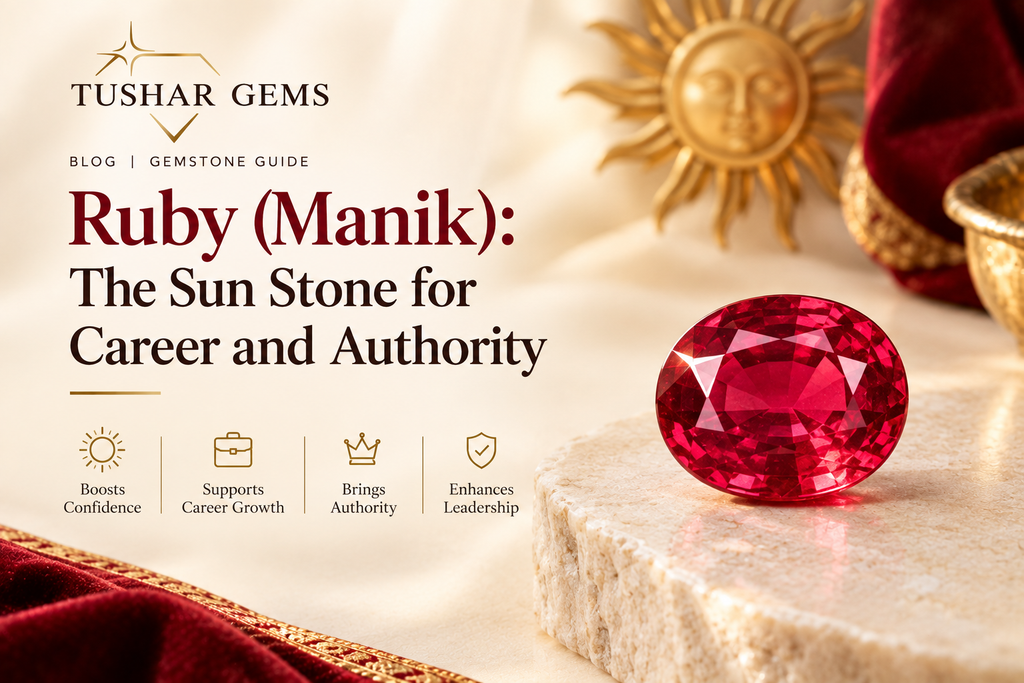
Ruby (Manik): The Sun Stone for Career and Authority
Published by Tushar Gems & Jewellery Pvt. Ltd. — Gurugram & Delhi | Natural · Certified · Trusted | Since 1998
Ruby is the king of the navratna, and it is sold like one — with confidence, with ceremony, and very often with a story that falls apart under a lab test.
Customers usually come to us for Manik with a specific hope: a promotion that keeps slipping, a government job, recognition that has not arrived. Those are exactly the hopes Vedic tradition connects with the Sun. But the Sun is also the planet that astrologers are most careful about strengthening, and the ruby market has one of the most widespread mis-selling problems in the trade. Both deserve a clear explanation.
What Manik actually is
Ruby is the red variety of corundum — the same mineral as blue and yellow sapphire. Chromium gives it the red colour. It sits at 9 on the Mohs hardness scale, which makes it tough enough to wear every day for a lifetime.
In Vedic astrology it belongs to Surya (the Sun) — the planet of authority, self-confidence, leadership, the father, government and reputation.
Who is traditionally advised to wear Ruby
- Simha (Leo) — ruled by the Sun, so Manik is its primary stone
- People running a Sun mahadasha or antardasha
- Charts where the Sun is weak but well-placed — Mesha (Aries), Kark (Cancer), Vrischik (Scorpio) and Dhanu (Sagittarius) ascendants are commonly considered, though the full chart decides
- Traditionally recommended where the concern is career growth, leadership roles, government work or self-confidence
Where astrologers are careful
The Sun is debilitated in Tula (Libra), and for some ascendants it rules houses that make strengthening it undesirable — Makar (Capricorn), Kumbha (Aquarius), Vrishabha (Taurus) and Tula charts are the ones examined most carefully. A strong Sun in the wrong chart is traditionally associated with ego clashes and friction with authority rather than recognition from it.
This is why we do not recommend a Manik without birth details — and why our kundli consultation at the store is free. The consultation costs you nothing. The wrong ruby costs you a great deal.
The glass-filled ruby problem
This is the single most important thing to know before buying a ruby in India.
Low-grade, heavily fractured ruby can be filled with lead glass. The glass fills the cracks, the stone suddenly looks clean and bright, and it can be sold at a price that seems like a bargain for a large, clear, red "Manik". In some of these stones the glass makes up a significant part of the material. Gemmologists call them composite rubies.
| Natural ruby | Lead-glass-filled (composite) ruby | |
|---|---|---|
| What it is | Corundum, possibly heat-treated | Fractured corundum held together and brightened by glass |
| Durability | Hardness 9, very tough | Glass can be damaged by heat, acids, even lemon juice and jeweller's torches |
| Price | Rises steeply with quality and size | A small fraction of a natural ruby |
| Astrological use | Untreated stones are what tradition prescribes | Not appropriate |
| On the certificate | "Natural corundum, variety ruby" | Should state glass filling or "composite" |
If a large, eye-clean ruby is offered at a price that sounds too good, read the treatment line on the certificate before anything else.
Judging a ruby
Colour. The most valued rubies are a pure to slightly purplish red with strong saturation. Too pink and it moves toward pink sapphire; too brown or dark and it looks dull indoors.
Clarity. Natural rubies are included. Eye-visible cracks that reach the surface matter; fine internal silk usually does not.
Origin. Burma (Myanmar) is the historic prestige source. Mozambique and other African deposits now supply much of the market, and Thai material is widely traded. Origin affects price and belongs on paper, not just in the sales pitch.
Treatment. Heat treatment is common and accepted in jewellery. For astrological wear, look for untreated — and treat glass filling as a hard no.
Wearing rules for Manik
| Detail | Traditional guidance |
|---|---|
| Planet | Surya (Sun) |
| Day to first wear | Sunday, morning, during Surya hora |
| Metal | Gold or Panchdhatu |
| Finger | Ring finger |
| Hand | Right hand for men, left hand for women |
| Setting | Open-back, so the stone touches the skin |
| Mantra | Om Hraam Hreem Hraum Sah Suryaya Namah |
If a natural ruby is out of reach
Tradition allows Red Garnet as a substitute for the Sun, and some traditions use Sunstone. Both are natural and far more affordable. A substitute does not carry the rarity or strength attributed to a fine Manik — but an honest garnet is a far better purchase than a glass-filled "ruby" at a ruby price.
Frequently asked questions
Is heated ruby fake?
No. It is genuine corundum and perfectly good in jewellery. Glass-filled ruby is a different matter entirely.
Can I wear Manik with Neelam or Heera?
Sun with Saturn and Sun with Venus are pairings traditionally avoided. Check the chart before buying either.
Is Burmese ruby always better?
Not automatically. A fine African ruby beats a poor Burmese one. Judge the stone, then the origin.
How soon does Manik show results?
Experiences vary from person to person. We prefer honest expectations to promises.
Come and see it under proper light
Bring your birth details for a free kundli consultation, and we will show you natural ruby with the certificate and treatment status on paper before any money changes hands.
Tushar Gems & Jewellery Pvt. Ltd. — open all seven days, 11 AM–8 PM
Gurugram: Shop No. 19–20, 2nd Floor, Gold Souk Mall, Sushant Lok 1, Sector 43, Gurugram, Haryana 122009
Delhi: 36/3092 Beadon Pura, Karol Bagh, New Delhi 110005 · 72899 15171 / 93550 55519
Phone & WhatsApp: +91 95400 05349 · tushargems2026@gmail.com
tushargems.com
Your Gems, Your Destiny.
Disclaimer: Gemstone recommendations described in this article are based on traditional Vedic astrology and are shared for informational purposes. They are not a substitute for medical, financial or legal advice.
-
Posted in
gemstone guide, manik, ruby, surya, vedic astrology

:%20The%20Sun%20Stone%20for%20Career%20and%20Authority)