Which Gemstone Should You Wear? A Rashi-Wise Guide to Choosing the Right Ratna
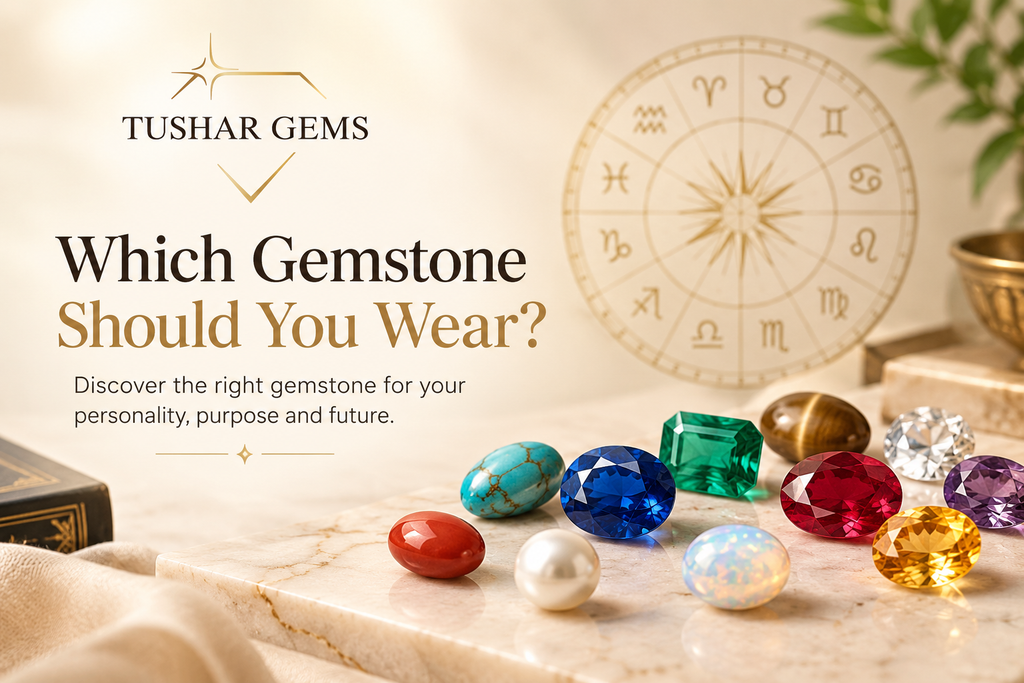
Published by Tushar Gems & Jewellery Pvt. Ltd. — Gurugram | Natural · Certified · Trusted | Since 1998
“Mera stone kaun sa hai?”
It is the first question almost every customer asks when they walk into our store at Gold Souk Mall, Gurugram. And it is a fair question — a gemstone is not a fashion purchase you make twice a year. You wear it every single day, against your skin, often for decades.
The internet will give you a fast answer: pick your zodiac sign, read the stone next to it, buy it. That answer is not wrong, but it is incomplete — and buying a stone on incomplete information is how people end up with a ring they stop wearing after three months.
This guide gives you the full picture: the rashi-wise chart, the five things that actually decide whether a ratna is worn correctly, and the questions you should ask any seller before you pay.
First, the honest part: your rashi is the starting point, not the final answer
In Vedic astrology, a gemstone is worn to strengthen a planet. Which planet needs strengthening depends on your complete birth chart — your kundli — not only on your moon sign.
Two people born under the same rashi can need two different stones, because their planetary positions, houses, and the mahadasha (planetary period) they are currently running are different.
This is why our own sales rule at Tushar Gems is simple and non-negotiable: we never recommend a gemstone without asking for your birth details first. If you are unsure about your chart, we would rather you sit with an astrologer before you spend a rupee on a stone. A gemstone bought without a kundli check is a guess, however beautiful the stone is.
How an astrologer typically works it out:
- Analyse the birth chart – identify your ascendant (Lagna) and which planets are strong or weak.
- Find the favourable planets – planets that are beneficial for your ascendant are usually the ones strengthened.
- Match the gemstone – each planet has one primary gemstone (e.g. Jupiter → Yellow Sapphire).
With that said, here is the traditional rashi-wise mapping — the best possible starting point.
Rashi-wise gemstone chart (all 12 signs)
| Rashi (Zodiac) | Ruling planet | Primary gemstone | Common substitute |
|---|---|---|---|
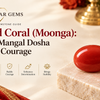
| Mesha (Aries) | Mangal / Mars | Red Coral (Moonga) | Coral |
| Vrishabha (Taurus) | Shukra / Venus | Diamond (Heera) | Opal, White Sapphire |
| Mithuna (Gemini) | Budh / Mercury | Emerald (Panna) | Green Onyx |
| Kark (Cancer) | Chandra / Moon | Pearl (Moti) | Moonstone |
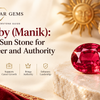
| Simha (Leo) | Surya / Sun | Ruby (Manik) | Sunstone |
| Kanya (Virgo) | Budh / Mercury | Emerald (Panna) | Green Onyx |
| Tula (Libra) | Shukra / Venus | Diamond (Heera) | Opal, White Sapphire |
| Vrischik (Scorpio) | Mangal / Mars | Red Coral (Moonga) | Coral |
| Dhanu (Sagittarius) | Brihaspati / Jupiter | Yellow Sapphire (Pukhraj) | Citrine, Yellow Topaz |
| Makar (Capricorn) | Shani / Saturn | Blue Sapphire (Neelam) | Iolite, Amethyst |
| Kumbha (Aquarius) | Shani / Saturn | Blue Sapphire (Neelam) | Iolite, Amethyst |
| Meena (Pisces) | Brihaspati / Jupiter | Yellow Sapphire (Pukhraj) | Citrine, Yellow Topaz |
Two shadow planets sit outside this table but matter a great deal in Indian astrology: Rahu, for which Hessonite (Gomed) is worn, and Ketu, for which Cat's Eye (Lehsunia) is worn. Both are traditionally worn on a Saturday.
The five things that decide whether a ratna is worn correctly
Choosing the stone is only the first of five decisions. Our sales team is trained to confirm all five before any order is finalised, and you should expect the same standard from anyone you buy from.
1. The right gemstone — matched to the planet your chart actually needs strengthened.
2. The right finger — each stone has a traditional finger, because each finger is associated with a planet.
- Little finger: Emerald, Natural Pearl
- Ring finger: Ruby, Red Coral
- Index finger: Yellow Sapphire
- Middle finger: Blue Sapphire, White Sapphire, Cat's Eye, Hessonite
A note many people miss: men traditionally wear the gemstone ring on the right hand, women on the left.
3. The right metal — the metal carries the stone's energy, so it is not an aesthetic choice alone.
| Gemstone | Planet | Wearing day | Recommended metal |
|---|---|---|---|
| Ruby (Manik) | Sun | Sunday | Gold / Panchdhatu |
| Pearl (Moti) | Moon | Monday | Silver |
| Red Coral (Moonga) | Mars | Tuesday | Copper / Gold / Panchdhatu |
| Emerald (Panna) | Mercury | Wednesday | Silver |
| Yellow Sapphire (Pukhraj) | Jupiter | Thursday | Gold / Panchdhatu |
| Diamond / Opal / White Sapphire | Venus | Friday | White Gold / Silver |
| Blue Sapphire (Neelam) | Saturn | Saturday | Silver / Panchdhatu |
| Hessonite (Gomed) | Rahu | Saturday | Silver |
| Cat's Eye (Lehsunia) | Ketu | Saturday | Silver |
4. The right day and muhurat — the stone is first worn on the day ruled by its planet, at an auspicious time, after the ring has been energised.
5. The right weight — too light and the stone is considered ineffective; the weight is prescribed according to your chart, not your budget.
The traditional formula our training manual uses says it best: right gemstone + right planet + right house + right finger + right metal + right weight = maximum benefit.
Ratti or carat — what should you actually ask for?
This confuses almost every first-time buyer. Both are units of weight for the same stone.
- Carat is the international unit: 1 carat = 200 mg (0.20 g)
- Ratti is the traditional Indian unit used in astrology
The conversion is straightforward:
- 1 ratti ≈ 0.91 carat
- 1 carat ≈ 1.10 ratti
- To convert: carat × 1.10 = ratti, and ratti × 0.91 = carat
So if your astrologer has advised a 5 ratti Pukhraj, you are looking for a stone of roughly 4.55 carats. Always confirm which unit the seller is quoting — the price difference between the two readings of the same number is significant.
Natural, untreated, certified — the part most buyers skip
Here is the uncomfortable truth of the gemstone trade: a large share of coloured stones in the market are treated. Heat, oil, glass filling, dye — these treatments improve how a stone looks and lower what it costs.
For jewellery, a treated stone can be a perfectly reasonable purchase. For astrological use, it is not. A stone worn to strengthen a planet is expected to be natural and untreated.
The four most common buying traps:
- The glass trap: many “cheap” stones are lead-glass filled. They look beautiful in photos but have no astrological value.
- Heating and diffusion: for astrology you need stones that are unheated and untreated.
- The wrong metal: setting a stone in a metal that doesn’t suit its planet — always confirm gold, silver or panchdhatu with an expert.
- The blind purchase: buying without a lab certificate from a reputable, independent laboratory.
Three questions to ask before you buy any ratna:
- Is it natural and untreated? Ask for it in writing, not just verbally.
- Is it certified? Every stone we sell is IIGJ certified, and the certificate travels with the stone.
- What is the origin — and does the certificate say so? Origin drives quality, rarity and price. Ceylon (Sri Lankan) sapphires, African rubies, Zambian and Colombian emeralds all command different values.
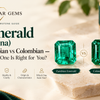
Emerald is the clearest example of why origin matters. Zambian emeralds are typically a deep green and available natural and untreated — which is why we recommend them for astrological use. Colombian emeralds are usually lighter, and much of the market supply is oil-treated — beautiful in jewellery, but we position them as jewellery stones, not astrological ones. Any seller who blurs that line is not being straight with you.
Substitutes: useful, affordable, and not the same thing
Precious stones are expensive because they are rare. When a prescribed stone is out of reach, Vedic tradition allows substitutes — a lighter, more affordable stone linked to the same planet:
- Yellow Sapphire → Citrine (Sunela)
- Blue Sapphire → Iolite (Kaka Neeli)
- Ruby → Red Garnet
- Emerald → Green Onyx
Substitutes are genuine, natural stones and a sensible way to start. But we will always tell you the same thing at the counter: a substitute does not carry the rarity, the market value, or the strength attributed to the original. Anyone promising you identical results from a substitute is selling, not advising.
Alongside these sit our fashion and semi-precious range — Amethyst, Rose Quartz, Aquamarine, Lapis Lazuli, Garnet, Tiger Eye, Moonstone — chosen for beauty and everyday wear rather than for a birth chart.
Traditional recommendations by purpose
When customers come to us with a specific concern rather than a chart, these are the associations Vedic tradition draws on most often:
| What you are seeking | Traditionally associated stone |
|---|---|
| Career or a new job | Ruby (Manik) |
| Growth in business | Ruby (Manik) |
| Education and focus | Emerald (Panna) |
| Marriage and partnership | Yellow Sapphire (Pukhraj) |
| Santaan prapti (childbirth) | Red Coral, Opal |
Treat this as a conversation starter, not a prescription. The chart still decides.
One last step people forget: energising the stone
A gemstone is traditionally energised (pran pratishtha) before it is worn for the first time:
- Cleanse: dip the ring or pendant in raw milk and Ganga Jal.
- Energise: chant the planet’s beej mantra 108 times during its hora on its designated day.
- Donate: it is a beautiful tradition to give a small amount to charity, or feed an animal linked to that planet, before first wearing the stone.
We guide every customer through this process when the ring or pendant is delivered, so the stone begins its life on your finger correctly.
Frequently asked questions
Can I wear a gemstone without checking my kundli?
We do not recommend it. The right stone depends on planetary positions and your running dasha — a rashi chart alone cannot tell you that.
Can I wear two gemstones together?
Sometimes, but not every combination is advised, as certain planets are considered inharmonious — Blue Sapphire with Diamond is one pair astrologers check carefully. This must be checked against your chart before you buy either stone.
How do I know my stone is real?
Insist on a certificate from a recognised laboratory — ours are IIGJ certified — and check that it names the stone, its weight, its origin and any treatment.
Is a bigger stone always better?
No. The correct weight is prescribed for your chart. Paying for extra carats you were not advised to wear is money spent on nothing.
How long before a gemstone shows results?
Traditional guidance places it within a few weeks to a few months, and it varies from person to person. We would rather set honest expectations than make promises.
Talk to us before you buy
We have been in fine minerals since 1998, and we have built the business on one simple principle: from mines to market, with trust and transparency. Bring us your birth details or your astrologer's recommendation, and we will help you get all five decisions right — stone, finger, metal, day and weight.
Tushar Gems & Jewellery Pvt. Ltd.
19–20, Second Floor, Sushant Lok-1, Gold Souk Mall, Gurugram, Haryana 122003
+91 95400 05348 · tushargems2026@gmail.com
tushargems.com
Your Gems, Your Destiny.
Disclaimer: Gemstone recommendations described in this article are based on traditional Vedic astrology and are shared for informational purposes. They are not a substitute for medical, financial or legal advice.
-
Posted in
gemstone guide, rashi ratna, vedic astrology, zodiac gemstones