
Shocking Truth: Why 80% Gemstones in the Market Are Fake?
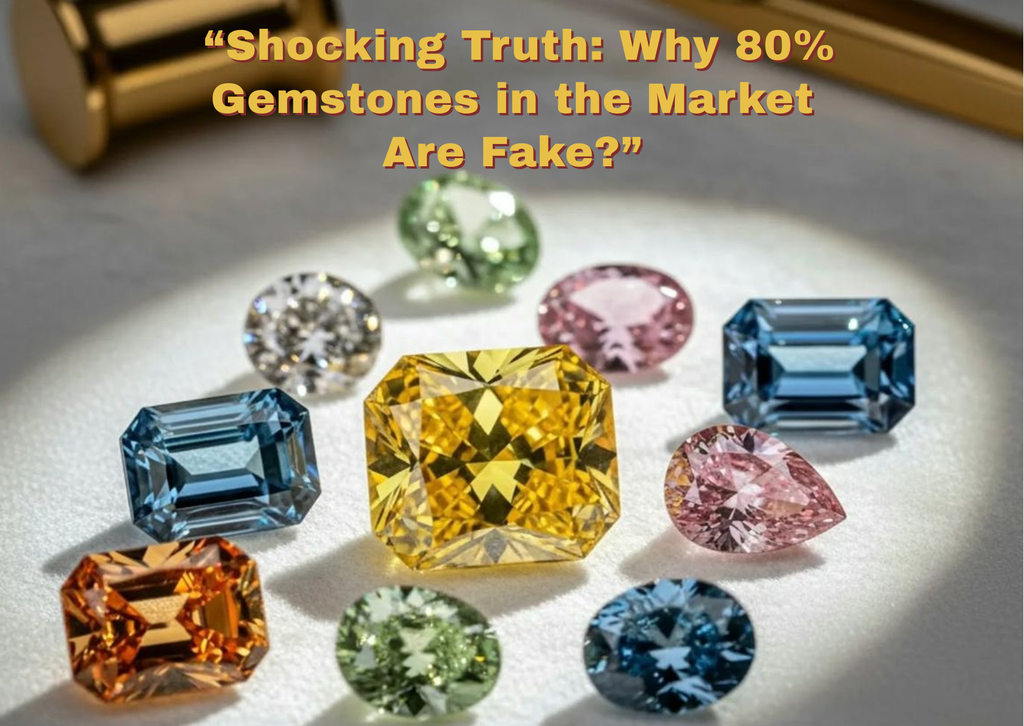
Shocking Truth: Why 80% of Gemstones in the Market Are Fake?
The world of gemstones is dazzling, colored with the promise of luxury, healing energies, and timeless value. However, beneath the sparkling surface of the jewelry industry lies a dark, lucrative secret. Experts estimate that up to 80% of gemstones currently circulating in the global market are fake, synthetic, or heavily manipulated.
Whether you are an investor looking for a high-value emerald or a spiritual seeker buying a crystal for its "vibe," the odds are stacked against you. In this deep dive, we reveal how the market became flooded with counterfeits and how you can protect your wallet.
The Rise of "Lab-Grown" vs. "Simulants"
To understand the "fake" epidemic, we first have to distinguish between the different types of non-natural stones. Not everything that isn't mined is technically "fake," but if it’s sold as "natural," it’s a scam.
1. Synthetic Gemstones (Lab-Grown)
These are chemically, physically, and optically identical to natural stones. A lab-grown ruby is, for all intents and purposes, a ruby. However, because they are mass-produced in weeks rather than forged over millions of years, their value is a fraction of the natural version.
-
The Scam: Selling a lab-grown sapphire at the price of a rare, "no-heat" natural Kashmir sapphire.
2. Simulants
These are the true "fakes." They look like the real deal but have a completely different chemical makeup.
-
Examples: Cubic Zirconia (CZ) or Moissanite sold as Diamonds; Green Glass or dyed Quartz sold as Emeralds.
3. "Frankenstein" Stones (Composites)
This is where it gets tricky. Many stones are "natural" but have been so heavily treated they are essentially junk.
-
Glass Filling: Rubies are often filled with lead glass to hide massive cracks. In some cases, the "ruby" is 40% glass by weight.
-
Doublets and Triplets: A thin slice of real opal or emerald is glued onto a piece of black plastic or green glass to make it look like a thick, high-quality gem.
Why is the Market Flooded?
The Demand-Supply Gap
The world’s supply of high-quality, ethically mined stones is shrinking. As mines in Myanmar (Burma), Colombia, and Sri Lanka become depleted, the demand for affordable luxury has skyrocketed. Manufacturers have filled this gap with high-tech imitations that can fool even seasoned hobbyists.
Lack of Regulation in Tourism Hubs
If you’ve ever bought a "bargain" gemstone while vacationing in Jaipur, Bangkok, or Istanbul, there is a high probability you bought glass or synthetic material. These markets often lack the strict consumer protection laws found in the West, and "authentic certificates" provided by the seller are often printed in the back of the shop.
The "Aura" of Healing Crystals
The recent explosion of the "crystal healing" trend has led to a massive influx of dyed stones. Aura Quartz, for example, is just clear quartz sprayed with metal fumes. While pretty, many "Citrine" stones on the market are actually low-grade Amethyst that has been heat-treated in an oven to turn it orange.
How to Spot a Fake: Red Flags to Watch For
While a professional lab test is the only 100% way to know, keep these indicators in mind:
| Red Flag | What it Usually Means |
| "Too Perfect" | Natural stones almost always have "inclusions" (tiny flaws). If it looks like flawless glass, it probably is. |
| Price is Too Good | If a 2-carat Royal Blue Sapphire is $50, it is 100% fake. Natural stones of that quality cost thousands. |
| Bubbles | If you see tiny round air bubbles under a magnifying glass, you are looking at glass, not a crystal structure. |
| Dye in Cracks |
If the color looks "concentrated" in the cracks of the stone, it has been dyed. |
The Anatomy of a "Fake": What Are You Actually Buying?
In the gem trade, the word "fake" covers a wide spectrum. It isn’t always just plastic or glass; often, it’s a sophisticated deception designed to mimic the physical properties of a natural stone.
A. Synthetic Gemstones (The Lab-Grown Deception)
Synthetic stones, such as lab-grown diamonds or Czochralski-pulled rubies, are chemically identical to natural stones. They have the same hardness, refractive index, and chemical formula.
-
The Catch: While they are "real" minerals, they lack the rarity and resale value of earth-mined gems. Selling a synthetic stone as "natural" is the most common form of fraud in the luxury market.
B. Simulants (The Visual Mimics)
Simulants only look like the real thing. A common example is Cubic Zirconia (CZ) or Moissanite being sold as a Diamond. Similarly, Spinels or Garnets are often mislabeled as Rubies to fetch a higher price.
C. Treated and Enhanced Stones
This is the "grey area" where most of the 80% figure comes from. A stone might be natural, but its quality is so poor that it has been "doctored":
-
Glass Filling: Low-grade rubies are filled with lead glass to hide cracks. These stones are fragile and can shatter if exposed to household cleaning chemicals.
-
Diffusion Treatment: Sapphires are heated with beryllium to artificially force a deep blue or orange color into the surface of the stone.
-
Dyeing: Poor quality, porous stones (like Howlite) are dyed bright blue and sold as "Genuine Turquoise."
Why is the Market Flooded with Counterfeits?
The "Amazon" and "Etsy" Effect
The rise of e-commerce has made it easier than ever for unscrupulous sellers in "source countries" to reach Western buyers directly. Without the oversight of a physical jewelry store or a master gemologist, these sellers can list "Natural Grade AAAA Emeralds" for $20. In reality, these are often hydrothermal synthetic emeralds produced in factories.
The Surge in "Healing Crystal" Trends
The wellness industry has created a massive demand for stones like Citrine, Rose Quartz, and Amethyst. Because most buyers in this niche are looking for "energy" rather than investment-grade minerals, sellers frequently use:
-
Heat-Treated Amethyst: 90% of the "Citrine" on the market is actually purple Amethyst that has been baked in an industrial oven until it turns burnt orange.
-
Aura Quartz: This is just clear quartz bonded with metal vapors to create a rainbow sheen—an entirely man-made process.
3. Top Red Flags: How to Spot a Fake Gemstone
While you can’t replace a laboratory's spectroscope or refractometer, you can use these professional tips to vet your next purchase:
-
The Flawless Trap: Natural stones are products of the earth. They contain "inclusions"—tiny bits of dust, minerals, or fractures. If a stone is "eye-clean" and costs less than a used car, it is likely glass or synthetic.
-
Temperature Check: Real gemstones (especially quartz and diamonds) feel cold to the touch for a few seconds because they conduct heat away from your skin. Plastic and glass fakes usually feel "room temperature" or warm.
-
The "Luster" Test: Look at the surface. Glass fakes often show "mold marks" or rounded edges on the facets, whereas genuine gemstones are cut with sharp, crisp angles.
-
The Bubble Clue: If you see tiny, perfectly round air bubbles inside the stone using a 10x loupe, it is almost certainly glass.
Summary of Common Gemstone Substitutes
| Natural Stone | Common Fake/Substitute | Detection Method |
| Diamond | Moissanite / CZ | Electrical conductivity test |
| Ruby | Glass-filled Ruby / Red Spinel | Look for "blue flashes" in glass filler |
| Emerald | Green Glass / Doublets | Look for glue lines at the "girdle" |
| Turquoise | Dyed Howlite / Plastic | Acetone (nail polish remover) test for dye |
| Citrine | Heat-Treated Amethyst | Look for white "root" at the base |
“At Tushar Gems, we provide 100% certified, astrologer-approved gemstones with 28+ years of trust — so you never risk wearing the wrong stone.”