The Soul of the Emerald: Why Color, Clarity, and Life Define the Ultimate Gemstone
Emeralds have long been the "crown jewel" of the gemstone world. From the legendary mines of Colombia to the vibrant deposits in Zambia and Brazil, these lush green stones have captivated royalty and collectors for millennia. But what exactly makes one emerald worth a small fortune while another is merely a pretty stone?
The secret lies in a delicate balance of three pillars: Color, Clarity, and that elusive quality experts call "Life."
1. The Power of Color: Vividness and Saturation
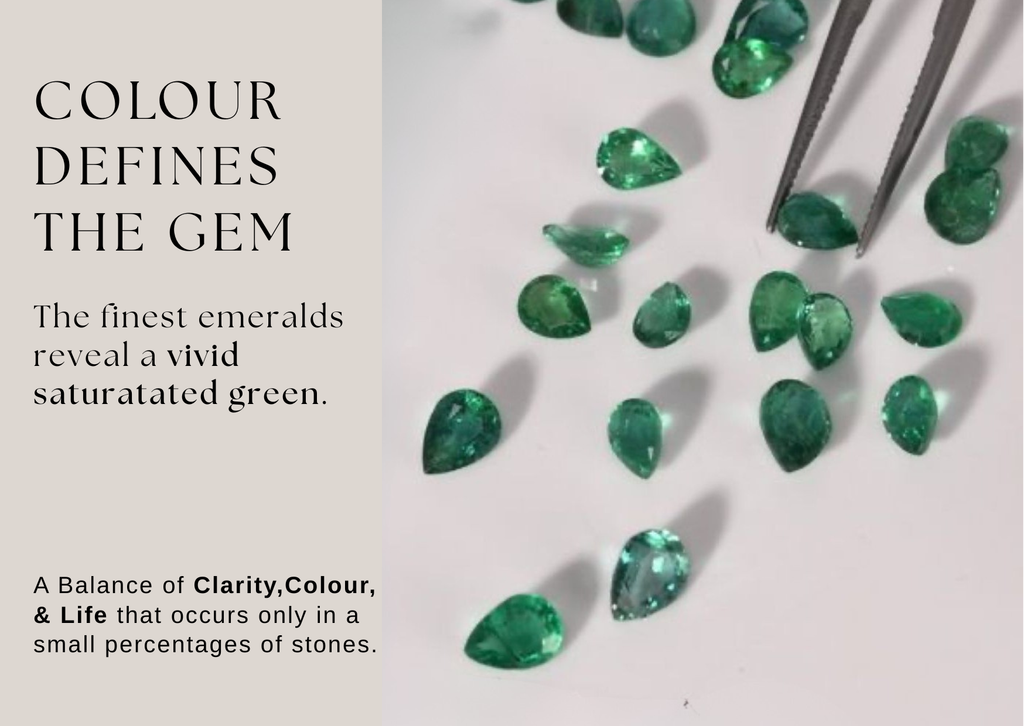
In the world of colored gemstones, color is king. For emeralds, the most desirable shade is a vivid, saturated green.
-
Hue: The primary color must be a pure, grassy green. While many emeralds have a slight blue or yellow secondary undertone, the most valuable stones lean toward a "bluish-green" that remains intense under different lighting.
-
Saturation: This refers to the strength or intensity of the color. A high-quality emerald doesn't just look green; it looks glowingly green.
-
Tone: The best stones sit in the medium-to-dark range. If the tone is too light, the stone is often classified as a "Green Beryl" rather than a true Emerald.
2. Clarity and the "Jardin"
Unlike diamonds, where inclusions are often seen as flaws, emeralds are expected to have internal characteristics. These natural inclusions are poetically referred to as the "Jardin" (French for garden).
-
Natural Fingerprints: A completely eye-clean emerald is incredibly rare. The presence of a "jardin" actually serves as proof of the stone's organic, natural origin.
-
The Balancing Act: The goal is to find a stone where the inclusions do not interfere with the overall transparency or structural integrity. When a stone manages to be both highly transparent and deeply colored, it belongs to the top 1% of emeralds worldwide.
3. "Life" – The Spark Within
Beyond the technical grades, there is a quality called Life. This is the brilliance, the scintillation, and the way the stone "talks" when it catches the light.
A stone with "Life" has a certain internal fire. It isn't dull or "sleepy." This is often achieved through a combination of a master-grade cut (like the classic Emerald Cut or a precise Pear Shape) and the stone's natural crystal quality. When a gem has "Life," it appears to be lit from within.
Investing in Authenticity
Because high-quality emeralds are so rare, the market is unfortunately filled with fakes and heavy treatments. When looking for a masterpiece, focus on:
-
Origin: Knowing where the stone was mined can significantly impact its value.
-
Treatment Disclosure: Most emeralds are "oiled" to fill surface-reaching fissures. Knowing whether a stone is "Minor Oil" or "Significant Oil" is crucial for pricing.
-
Certification: Always insist on a reputable lab report to verify that the stone is a Natural Emerald.
Summary for Collectors
An emerald is more than just a green rock; it is a balance of nature’s chaotic beauty and perfect geometry. Whether you are looking for a statement ring or a long-term investment, remember that Color defines the gem, but Clarity and Life give it a soul.
The Supremacy of Color: Vividness and Saturation
In the gemstone industry, color is the single most important factor in determining price and desirability. For an emerald to be considered "top-tier," it must exhibit a vivid, saturated green.
-
Hue: The most prized emeralds feature a primary green hue with a slight bluish-green secondary tone. If the stone is too yellow or too blue, it loses its "royal" status.
-
Saturation: This is what gives the stone its "glow." High saturation means the color is intense and rich, rather than dull or grayish.
-
Tone: The best emeralds sit comfortably in the 70% to 80% tone range. If a stone is too dark, it looks black in low light; if it is too light, it is simply "Green Beryl."
Clarity and the "Jardin": Nature’s Signature
While diamonds are prized for being "flawless," emeralds are almost never found without inclusions. In fact, these internal markings are so characteristic that they are called the Jardin (the French word for "garden").
-
The Natural Proof: A "Jardin" consists of tiny liquid bubbles, crystals, and fissures. These aren't flaws; they are a fingerprint of the earth.
-
Transparency is Key: The rarest emeralds—the top 1% of stones—balance these inclusions with high transparency. When the stone allows light to pass through without being blocked by heavy "clouds," the color appears much more vibrant.
-
Eye-Clean vs. Specimen Grade: For investment-grade jewelry, seekers look for "eye-clean" stones where the inclusions are invisible to the naked eye, even if they are visible under a loupe.
The "Life" of the Stone: Brilliance and Scintillation
You might have two emeralds of the same color and weight, but one looks "dead" while the other seems to "dance." This internal fire is what experts call "Life."
-
The Cut: A master cutter knows how to orient the raw crystal to maximize light return. Whether it is a classic Octagon Emerald Cut, a Cushion Cut, or a Pear Shape, the facets must be precise to ensure the stone sparkles.
-
Refractive Quality: "Life" refers to the way light bounces inside the gem. A stone with "Life" has a certain crispness and brilliance that makes it stand out even across a crowded room.
Investing in Emeralds: What You Need to Know
Because the demand for natural, unheated, or minor-oil emeralds is at an all-time high, the market is competitive. Here are three tips for the modern collector:
-
Check for Origin: Colombian emeralds are legendary, but Zambian and Brazilian stones are gaining massive popularity for their unique clarity and "electric" green tones.
-
Verify Treatments: Most emeralds are treated with colorless oil to fill surface-reaching fissures. Always ask for a lab certificate (like GRS or GIA) to confirm if the oiling is "Minor," "Moderate," or "Significant."
-
Trust Your Eyes: Technical specs matter, but the "Life" of the stone is something you must feel. A gem that speaks to you is often more valuable than one that just looks good on paper.
Why Emeralds are the Future of Luxury
As global fashion shifts toward "quiet luxury" and sustainable, natural assets, gemstone jewelry has become a preferred investment. An emerald isn't just a fashion statement; it is a portable, tangible piece of history that retains its value over generations.
SEO Keywords for This Post:
-
Natural Emerald Gemstones
-
Vivid Saturated Green Emerald
-
Emerald Clarity and Jardin
-
Gemstone Investment 2026
-
Luxury Jewelry Trends
-
High-Quality Emerald Guide
-
Emerald vs Green Beryl
-
Gemstone Scintillation and Life