Real Truth Behind Gemstones – Science or Scam ?
The Real Truth Behind Gemstones: Science, Symbolism, or Scam?
Gemstones have captivated humanity for millennia. From the crown jewels of ancient monarchs to the high-tech precision of modern lasers, these compressed minerals carry immense value. But in a world of online marketplaces and spiritual influencers, a polarizing question arises: Is the power of gemstones rooted in science, or is it just a sophisticated scam?
To find the truth, we have to look at gemstones through three distinct lenses: Geology, Psychology, and Consumer Economics.
1. The Science: Why Gemstones are Geological Miracles
From a scientific perspective, gemstones are anything but a scam. They are extraordinary products of Earth’s extreme conditions.
-
Formation: Most gemstones form miles below the Earth's surface under intense heat and pressure. For instance, diamonds are pure carbon crystallized at depths of 100 miles, while emeralds require the rare meeting of beryllium and chromium.
-
Physical Properties: Science measures gemstones through Refractive Index (RI), Mohs Scale of Hardness, and Specific Gravity. A diamond’s brilliance isn't "magic"; it is the result of its high RI, which slows down and bends light more than almost any other substance.
-
Technological Utility: Rubies are used in lasers, sapphires create scratch-resistant watch faces, and quartz is the heartbeat of timekeeping because of its piezoelectric property (it generates an electric charge when under mechanical stress).
The Science Verdict: The physical value and technical utility of gemstones are 100% scientifically proven.
2. The Healing Perspective: Energy vs. Placebo
This is where the "scam" accusations usually begin. Millions of people believe in the metaphysical properties of stones—like Amethyst for peace or Citrine for wealth.
-
The Energy Argument: Proponents suggest that since gemstones have a stable molecular structure, they emit a constant frequency that can harmonize with the human "energy field."
-
The Scientific Counter: To date, there is no peer-reviewed empirical evidence suggesting that gemstones can heal physical diseases or alter luck.
-
The Power of Psychology (Placebo Effect): If wearing a specific gemstone makes a person feel more confident or calm, their behavior changes. This "Placebo Effect" is a documented psychological phenomenon. If you feel "lucky" wearing a Sapphire, you might take more risks that lead to success.
The Healing Verdict: It is subjective. While not medically proven, the psychological impact can be a powerful tool for mindfulness and intention-setting.
3. The "Scam" Factor: Where Consumers Get Fooled
The real "scam" in the gemstone industry isn't about energy; it’s about transparency and ethics. Because the market is high-value, it attracts deceptive practices.
-
Synthetics vs. Simulants: A "Lab-Grown" diamond is chemically identical to a mined one (Science). A "Cubic Zirconia" is a fake that just looks like a diamond (Simulant). Selling a simulant as a natural stone is a scam.
-
Undisclosed Treatments: Many stones are heat-treated, dyed, or glass-filled to improve color and clarity. This is a standard industry practice, but failing to disclose these treatments to a buyer is a scam.
-
Overpricing: Selling a common mineral with a fancy "spiritual" name at a 1000% markup is a frequent tactic in the "wellness" industry.
4. How to Ensure You Aren't Being Scammed
If you are buying gemstones—whether for investment, jewelry, or spiritual reasons—science is your best friend.
-
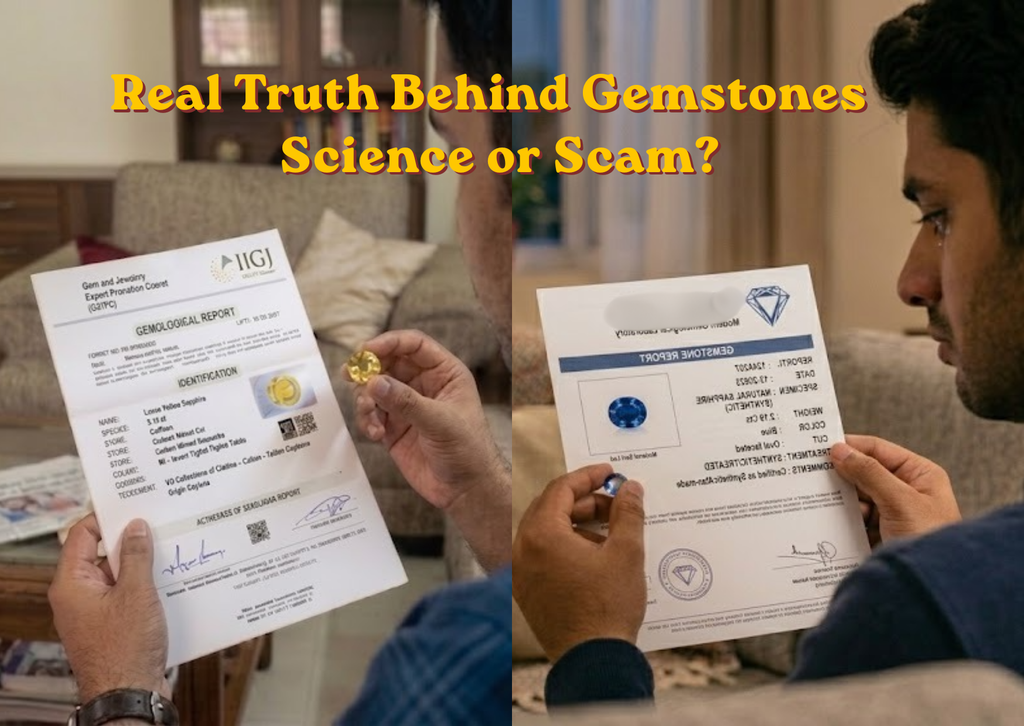
Demand Certification: Always ask for a report from a reputable lab (like GIA, IGI, or GJEPC). These labs use spectrometers and microscopes to prove the stone is what the seller claims it is.
-
Check for "Unheated" Status: In the world of precious stones like Rubies and Sapphires, "unheated" natural stones are significantly more valuable.
-
Know the 4Cs: For many stones, Color, Clarity, Cut, and Carat weight are the only scientific metrics for price.
Conclusion: Science or Scam?
The "Real Truth" is that gemstones are a blend of both. The science of their formation and physical properties is undeniable. However, the industry is rife with scams involving fake stones and undisclosed treatments.
As for the spiritual side? If a gemstone serves as a beautiful reminder of your goals, it holds value. But if a seller promises a "miracle cure" for a high price tag without a lab certificate—that is a scam.
SEO Keywords Included:
-
Real truth behind gemstones
-
Gemstone science or scam
-
Gemstone healing facts
-
Natural vs Synthetic gemstones
-
Gemstone investment guide
-
Unheated sapphire value
-
Lab-certified gemstones
-
Metaphysical properties of stones
-
Gemstone industry transparency
-
GJEPC and GIA certification
The Geological Reality: Nature’s High-Pressure Masterpieces
From a scientific standpoint, gemstones are anything but a scam. They are the result of extraordinary geological processes that occur over millions of years.
-
Formation Under Extreme Conditions: Most gemstones form deep within the Earth’s crust. For example, Diamonds are pure carbon crystallized under immense pressure and heat at depths of 100 miles. Emeralds require a rare "geological accident" where beryllium meets chromium or vanadium.
-
The Physics of Light: The beauty of a gemstone is pure physics. Concepts like Refractive Index (RI) and Dispersion explain why a diamond "sparkles" or why an opal shows a "play of color." This isn't magic; it is the manipulation of light through molecular structures.
-
Industrial Utility: Science proves the power of stones daily. Rubies are essential in laser technology, Sapphires (as synthetic alumina) make up scratch-resistant smartphone camera lenses, and Quartz is used in timekeeping because of its piezoelectric properties—it literally generates an electric pulse.
Verdict: Geologically and physically, gemstones are tangible miracles of nature with proven, measurable properties.
The Metaphysical Debate: Energy vs. Psychology
This is the most controversial aspect of the industry. Many believe that gemstones like Yellow Sapphire (Pukhraj) or Blue Sapphire (Neelam) can influence human destiny or health.
The "Frequency" Argument
Proponents of crystal healing argue that because gemstones have a highly organized and stable molecular lattice, they emit a consistent vibration. They claim these vibrations interact with the human "biofield."
The Scientific Counter-Argument
Mainstream science has yet to find empirical evidence that a stone sitting on your skin can cure a biological disease or change your financial luck. However, we cannot ignore the Placebo Effect.
-
The Power of Intention: If wearing a specific gemstone acts as a psychological "anchor," it can improve a person's focus and confidence.
-
Color Therapy: Science acknowledges that colors affect human mood (e.g., blue is calming, yellow is energizing). Wearing a vibrant gemstone can subconsciously shift your emotional state, leading to better decision-making.
When the Industry Becomes a Scam: The Red Flags
While the stones themselves are real, the trade can often involve deceptive practices. This is where the "scam" label becomes justified.
A. Undisclosed Treatments
Almost 90% of gemstones in the market undergo some form of "enhancement."
-
Heat Treatment: Common in Sapphires to improve color.
-
Glass Filling: Used in Rubies to hide cracks.
-
Dyeing: Making a cheap stone look like a premium one. The Scam: Selling a treated stone at the price of a "Natural, Unheated" stone without telling the buyer.
B. Synthetics vs. Simulants
-
Synthetic (Lab-Grown): These are chemically and physically identical to natural stones but made in a lab.
-
Simulants: These are fakes (like glass or plastic) that only look like the real thing. The Scam: Passing off a simulant or a lab-grown stone as a "Natural Mined Gemstone" to justify a high price.
C. The "Miracle Cure" Marketing
Any seller promising that a stone will "guarantee" a job promotion or "cure" a chronic illness within 24 hours is likely engaging in a scam. Gemstones are symbols and tools, not magic switches for life's problems.
How to Buy with Confidence: The Science of Verification
To avoid being scammed, you must rely on objective verification rather than the seller’s "story."
-
Demand a Lab Report: Never buy a high-value gemstone without a certificate from a reputable, independent laboratory (such as GIA, IGI, GJEPC, or IIGJ).
-
Check for "Unheated" Status: In the world of precious stones, a "Natural, Unheated" certificate can increase a stone's value by 3x to 10x.
-
Microscopic Inspection: Real gemstones usually have "inclusions" (tiny internal flaws). A stone that looks too perfect and is very cheap is likely glass or synthetic.
-
Physical Metrics: Use a refractometer to check the RI or a Chelsea filter to verify the color origin.
Conclusion: The Real Truth
Are gemstones a scam? No. They are rare, beautiful, and scientifically significant pieces of our planet's history.
However, the gemstone market can be a scam if you enter it without knowledge. The "Real Truth" is that a gemstone’s value is determined by its Rarity, Durability, and Authenticity, not by the myths surrounding it. If you value a stone for its geological wonder or as a beautiful personal symbol, it is a worthy investment. If you are looking for a "magic fix" from a suspicious seller, you are likely being targeted by a scam.
“At Tushar Gems, we provide 100% certified, astrologer-approved gemstones with 28+ years of trust — so you never risk wearing the wrong stone.”