6 Important Factors Know of Gemstone Certificate
1. The Reputation of the Gemological Laboratory
Not all certificates are created equal. A piece of paper is only as reliable as the institution that issued it. When checking a report, ensure it comes from a globally or nationally recognized laboratory.
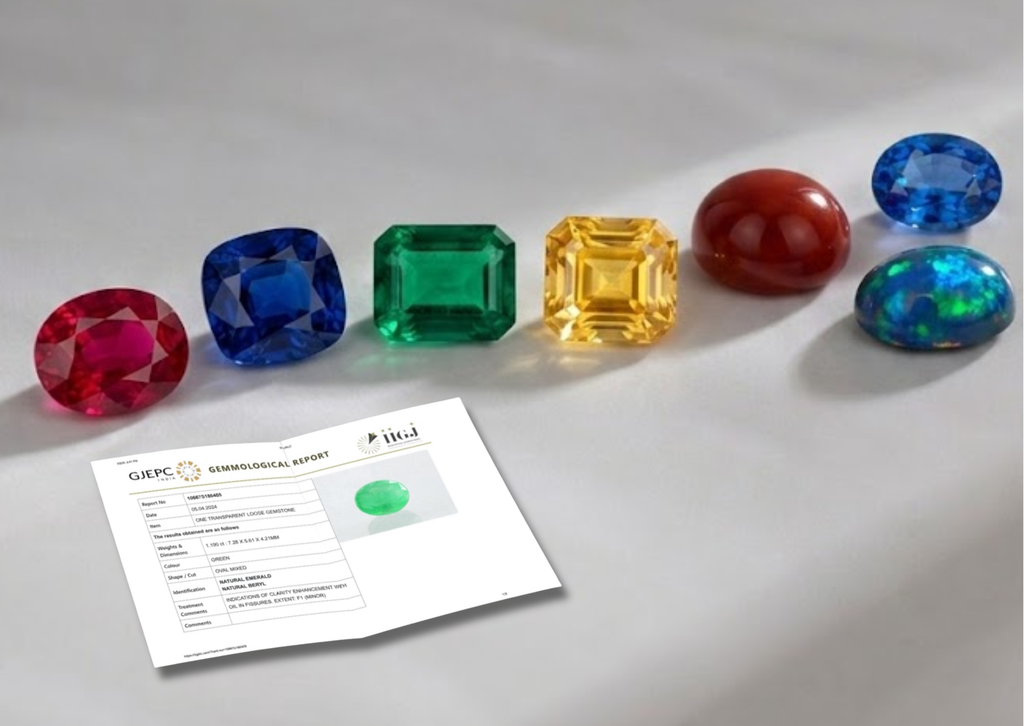
Laboratories like the GIA (Gemological Institute of America) prominent Indian institutions like IIGJ (Indian Institute of Gem & Jewellery) and GJEPC are known for their rigorous testing standards and unbiased grading. Avoid "in-house" certificates provided by a seller, as these may lack the objectivity required for a fair valuation.
2. Precise Identification and Variety
The certificate must clearly state what the stone is. This sounds simple, but it is the foundation of the report. It distinguishes between a Natural Sapphire and a Synthetic (Lab-Grown) Sapphire.
Furthermore, it should specify the variety. For example, in the case of Garnets, the report should clarify if it is a Tsavorite or a Rhodolite. For Tanzanite, the certificate confirms its rarity and distinct species. This identification is the first step in protecting yourself from fraud.
3. Detailed Color and Clarity Analysis
While diamonds have a standardized "4Cs" grading system, colored gemstones are more subjective. However, a good certificate will offer a detailed description:
-
Color: The report will define the Hue (the color itself), Tone (how light or dark), and Saturation (the intensity). Terms like "Royal Blue" or "Pigeon Blood Red" are often used to denote premium quality.
-
Clarity: It notes the presence of inclusions. In colored stones, "eye-clean" is the gold standard, though some inclusions (like "silk" in Rubies) can actually prove the stone’s natural origin.
4. Weight and Dimensions (The Carat Factor)
Precision is key. A certificate provides the exact Carat weight measured to two or three decimal places. It also lists the physical dimensions (length, width, and depth) in millimeters.
This data is crucial because two stones might look the same size from the top, but one might be "bottom-heavy," affecting how it sits in a jewelry setting and its overall price-per-carat.
5. Treatment and Enhancement Disclosure
This is perhaps the most critical section of a gemstone report. Most gemstones undergo some form of treatment to improve their appearance. Common treatments include:
-
Heat Treatment: Widely accepted for Sapphires and Rubies.
-
Oiling: Standard for Emeralds to fill surface-reaching fissures.
-
Diffusion or Irradiation: More "aggressive" treatments that significantly lower the stone's value compared to an untreated counterpart.
A certificate will explicitly state if a stone is "Natural/No Heat" or if it has been enhanced. Natural, untreated stones command a much higher premium.
6. Cut and Shape Specification
The cut of a gemstone determines its brilliance and how it interacts with light. Whether it is an Oval cut, Cushion cut, or Princess cut, the certificate will document the shape and the cutting style. A well-proportioned cut ensures that the "fire" of the stone is maximized, while a poor cut can make a high-quality stone look dull.
Why You Should Never Skip the Certificate
A certificate is more than just a document; it is your legal and financial safeguard. It ensures:
-
Resale Value: A certified stone is much easier to sell or upgrade in the future.
-
Insurance Accuracy: Insurance companies require official grading reports to value your jewelry correctly.
-
Peace of Mind: You know exactly what you are paying for, with no hidden surprises regarding treatments or origin.
SEO Keywords Included in this Guide:
-
Gemstone Certificate Importance
-
Natural Blue Sapphire Certification
-
IIGJ and GJEPC Certified
-
No Heat Ruby vs Treated Ruby
-
Emerald Oiling Disclosure
-
Gemstone Grading Report Factors
-
Authentic Pukhraj and Neelam
-
Gemstone Carat Weight Accuracy
“At Tushar Gems, we provide 100% certified, astrologer-approved gemstones with 28+ years of trust — so you never risk wearing the wrong stone.”