How to Identify a Real Blue Sapphire: Original vs Fake
Understanding the Basics: What is a Blue Sapphire?
A Blue Sapphire is a variety of the mineral Corundum. While pure corundum is colorless, the presence of trace elements like iron and titanium gives the Blue Sapphire its signature hue. On the Mohs scale of mineral hardness, Sapphires score a 9, making them the second hardest natural substance after diamonds.
1. The "Breath Test" (The Quick Fog Check)
One of the easiest ways to start your inspection is the breath test.
-
The Process: Hold the stone close to your mouth and breathe on it until it fogs up.
-
Original: Because sapphires have high thermal conductivity, the fog should disappear almost instantly (within 1–2 seconds).
-
Fake: If the stone is glass or a cheap imitation, the moisture will linger for several seconds or more.
2. The Inclusion Inspection (The Loupe Test)
Natural gemstones are formed deep within the earth over millions of years. This process leaves behind "birthmarks" known as inclusions.
-
Original: Under a 10x jeweler’s loupe, a real Blue Sapphire will often show natural flaws like silk (fine rutile needles), feathers, or small mineral crystals.
-
Fake: If a stone looks "perfect" or "flawless" to the naked eye at a low price, it is likely synthetic or glass. Furthermore, if you see tiny gas bubbles inside the stone, it is a definitive sign of glass or "Leaded Glass Filling." Natural sapphires do not have gas bubbles.
3. The Scratch Test (Checking Hardness)
As mentioned, Blue Sapphires are incredibly hard (9 on the Mohs scale).
-
Original: A real sapphire cannot be scratched by anything except a diamond or another sapphire.
-
Fake: If you can scratch the surface of the stone with a stainless steel knife or a piece of glass, it is not an original Blue Sapphire.
4. Color Consistency and Light Reflection
-
Original: When you rotate a natural sapphire under light, you may see a slight change in the shade of blue (a phenomenon called pleochroism). The color should feel deep and "inner-lit."
-
Fake: If the stone is "flame-fusion" synthetic, it may show curved color bands when viewed under magnification. Natural sapphires have straight or angular color zoning, never curved.
5. Check for "Leaded Glass" Fillings
Low-quality sapphires are often "treated" by filling cracks with blue-dyed lead glass to make them look high-quality.
-
How to tell: Look for "flash effects." If you see flashes of blue or purple light inside the cracks when moving the stone under a lamp, it has been glass-filled.
Summary Table: Original vs. Fake
| Feature | Original Blue Sapphire | Fake / Synthetic Sapphire |
| Inclusions | Fine silk, needles, or feathers | Gas bubbles or perfectly clear |
| Hardness | 9 (Only Diamond can scratch it) | Lower (Can be scratched by steel) |
| Color Lines | Straight or angular zoning | Curved lines (flame fusion) |
| Breath Test | Fog clears instantly | Fog lingers for 3+ seconds |
| Temperature | Stays cool to the touch | Warms up quickly |
The Only Foolproof Method: Lab Certification
While DIY tests are helpful for a preliminary check, the only way to be 100% certain is a Gemological Laboratory Certificate. Always insist on a certificate from a reputable, independent body (such as GIA, IIGJ, or GJEPC). These labs use advanced technology like X-ray fluorescence and spectrometers to identify the exact origin and treatment of the stone.
Microscopic Inspection: Inclusions vs. Bubbles
In the gemstone industry, "flawless" is a red flag. Natural stones grown deep within the earth always carry microscopic "birthmarks."
Natural Inclusions (The "Silk")
Under 10x or 30x magnification, look for:
-
Silk: Fine, needle-like inclusions of rutile that intersect at 60-degree angles.
-
Fingerprints: Tiny liquid-filled tubes that look like human fingerprints.
-
Color Zoning: Natural sapphires often have straight or angular bands of color. If you see curved color bands, the stone is a "Flame Fusion" synthetic.
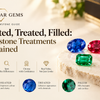
Understanding Common Treatments
A stone can be "real" (corundum) but not "natural" in its state. You must distinguish between:
-
Unheated/Natural: The most valuable. The color and clarity are exactly as they came from the earth.
-
Heat Treated: A common industry practice to improve color. While accepted, it should always be disclosed.
-
Lead-Glass Filled: Low-grade sapphire is filled with cobalt-blue glass to hide cracks. These stones have very little value and are prone to breaking. Look for a "flash effect" (blue or orange flashes) inside the cracks when moving the stone under a light.
Geographical Origin and Value
The origin of a Blue Sapphire significantly impacts its value and appearance.
-
Kashmir Sapphires: Known for a "velvety" blue glow; these are the rarest and most expensive.
-
Ceylon (Sri Lanka) Sapphires: Usually a bright, vivid cornflower blue. Highly sought after for jewelry.
-
Madagascar/African Sapphires: Often display excellent clarity and deep saturation.
“At Tushar Gems, we provide 100% certified, astrologer-approved gemstones with 28+ years of trust — so you never risk wearing the wrong stone.”