Real vs Fake Yellow Sapphire: The Identification Guide
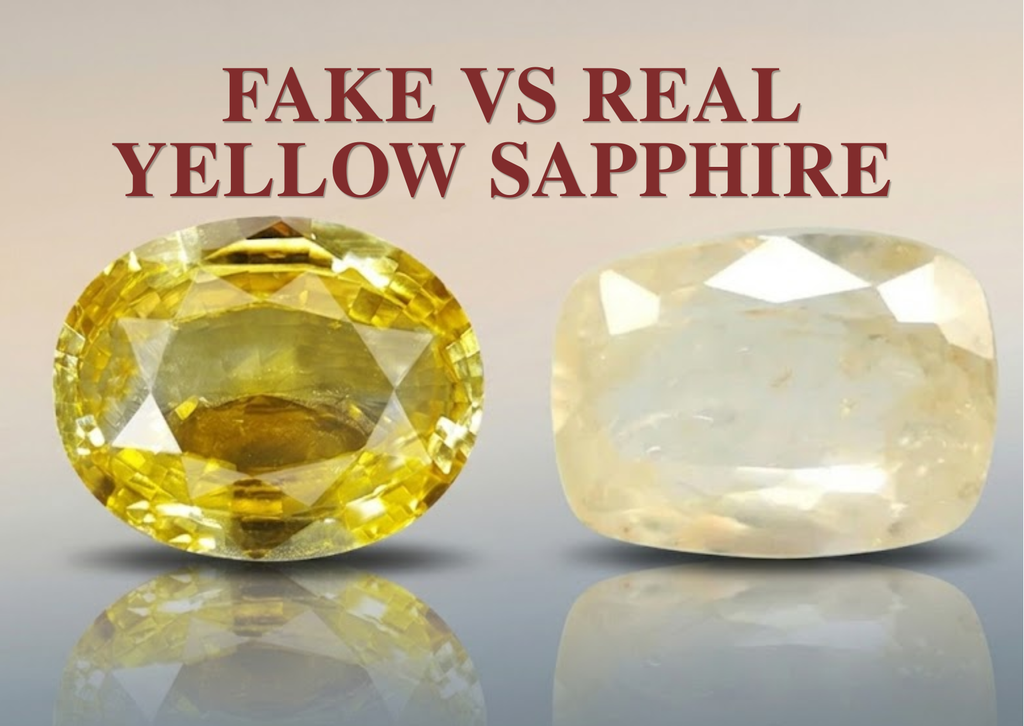
The Core Difference: Natural, Synthetic, and Imitation
Before diving into the tests, it is essential to understand what exactly makes a stone "fake" or "non-natural."
-
Natural Yellow Sapphire: Formed deep within the earth’s crust over millions of years under extreme heat and pressure. It contains distinct natural internal characteristics.
-
Synthetic/Lab-Grown Sapphire: These possess the exact same chemical composition ($Al_2O_3$) and physical properties as natural sapphires but are created in a laboratory within weeks. While they look visually perfect, they lack astrological value and natural rarity.
-
Imitation/Simulants: These are completely different materials made to look like Yellow Sapphire, such as colored glass, plastic, synthetic Chrysoberyl, or Yellow Cubic Zirconia.
7 Expert Ways to Identify an Original Yellow Sapphire (Pukhraj)
1. The Bubble Test (Spotting Glass Imitations)
One of the most common fakes in the commercial market is colored glass. Fortunately, glass leaves behind an unmistakable manufacturing footprint.
-
The Method: Clean your gemstone thoroughly and inspect it under a 10x jeweler’s loupe or a microscope beneath a bright, direct light source.
-
The Real Sign: A natural Pukhraj will never contain perfectly round, oval, or clustered air bubbles.
-
The Fake Sign: If you notice tiny, perfectly round air bubbles trapped inside the material, it is a definitive indicator of glass or glass-composite manufacturing.
2. Inspecting the Inclusions (The Gemstone's Fingerprints)
Nature is beautifully imperfect. A flawless, large gemstone is an absolute rarity in nature and commands an astronomical price tag.
-
The Method: Peer deep into the crystal structure under magnification.
-
The Real Sign: Genuine Yellow Sapphires feature organic, internal characteristics. Look for fine, angular needle-like structures (rutile needles known as 'silk'), liquid veils, feathers, or tiny negative crystals.
-
The Fake Sign: If the stone looks 100% crystal clear—like a drop of pure water—without a single internal mark, it is highly likely a lab-created synthetic stone or plastic.
3. The Hardness & Scratch Test
Yellow Sapphire is an exceptionally durable mineral belonging to the corundum family. On the Mohs scale of mineral hardness, it ranks at a 9, surpassed only by a diamond (10) and moissanite (9.25).
-
The Method: Evaluate the crispness of the stone’s facets or test its resistance against lower-ranked materials.
-
The Real Sign: Because it is incredibly hard, an original Pukhraj will easily scratch glass or a copper coin without sustaining any damage itself. Furthermore, the facet edges (the lines where the cuts meet) will always look sharp, crisp, and perfectly defined.
-
The Fake Sign: Imitations like glass or Citrine are much softer. Over time, their facet edges become rounded, blunt, or scuffed. If you see scratches on the surface of your stone from routine handling, it is not a genuine sapphire.
4. Color Uniformity and Hue Analysis
The color of a high-quality sapphire is derived naturally from trace elements of iron during its formation.
-
The Method: Observe the stone under natural, diffuse daylight against a neutral white background.
-
The Real Sign: A genuine stone exhibits a warm, rich, golden-yellow or lemon-yellow hue with a soft, velvet-like luster. While natural stones can display subtle color zoning (bands of lighter and darker yellow), the transitions look organically integrated.
-
The Fake Sign: Beware of stones that look overly vibrant, neon, or fluorescent yellow; this is a classic sign of artificial chemical dyes or radiation treatments. Additionally, if the color appears concentrated only along the surface cracks or looks like it is peeling at the edges, it is a dyed fake.
5. Light Dispersion and Refractive Index
Yellow Sapphires possess a high refractive index, which gives them a brilliant, sharp sparkle rather than a muddy or chaotic one.
-
The Method: Hold the gemstone under a bright flashlight or sunlight and observe the light reflecting off its facets.
-
The Real Sign: A natural Pukhraj reflects light efficiently, showcasing a bright, steady, and clean golden glow. It also displays a property called dichroism, meaning it may display slightly different shades of yellow when viewed from different angles.
-
The Fake Sign: Materials like Cubic Zirconia (CZ) have a high dispersion rate, causing them to throw intense, rainbow-like reflections. If your stone flashes strong reds, greens, and blues like a disco ball under the light, it is a synthetic simulant.
6. The Weight and Temperature Sensation
True gemstones possess high specific gravity (density) and excellent thermal conductivity.
-
The Method: Hold the stone in your palm to gauge its weight and temperature.
-
The Real Sign: An original Yellow Sapphire has a specific gravity of around 4.00, meaning it will feel surprisingly heavy or "substantial" for its visual size. It will also feel cool to the touch when first picked up and will dissipate your body heat rapidly.
-
The Fake Sign: Plastic and glass imitations feel light, hollow, and warm up to your body temperature almost instantly.
7. The Ultimate Safeguard: Lab Certification
While home tests provide an excellent preliminary screening, advanced laboratory treatments—such as beryllium diffusion, glass-filling, or synthetic flux-growth—can fool even seasoned jewelers without the proper equipment.
The only 100% foolproof method to ensure your investment is secure is to mandate an independent gemstone authenticity certificate.
What to check on a certificate:
Always ensure the report is issued by a highly reputed, independent gemological laboratory (such as GIA, IGI,IIGJ Bellerophon, or top-tier national labs). The certificate must explicitly state:
Species: Natural Corundum
Variety: Natural Yellow Sapphire
Treatment Status: Explicitly mentioning if the stone is "Unheated" or if it has undergone "Heat Treatment," "Glass Filling," or "Diffusion."
Summary Comparison: Real Pukhraj vs. Fake
| Feature | Real Yellow Sapphire (Natural) | Fake / Imitation Stone |
| Hardness (Mohs Scale) | 9 (Extremely hard, scratch-resistant) | 5 to 7 (Scratches easily, rounded facets) |
| Internal Characteristics | Natural inclusions (silk, feathers, needles) | Round air bubbles, flow lines, or completely flawless |
| Sparkle/Reflection | Brilliant, crisp, deep golden glow | Excessive rainbow flashes (CZ) or dull luster (Glass) |
| Weight Sensation | Feels heavy and dense in the hand | Feels unusually light or plasticky |
| Astrological Benefit | High (Especially if untreated/unheated) | None (Purely cosmetic) |
“At Tushar Gems, we provide 100% certified, astrologer-approved gemstones with 28+ years of trust — so you never risk wearing the wrong stone.”