How to Buy Authentic and Certified Gemstones Online: Buying Guide
Purchasing a gemstone is more than just a financial investment; it is an emotional journey. Whether you are buying a Natural Yellow Sapphire (Pukhraj) for astrological benefits, a deep Blue Sapphire (Neelam) for a custom engagement ring, or a vivid Emerald (Panna) to add to your luxury jewelry collection, buying online can feel intimidating.
With thousands of digital storefronts claiming to sell "100% natural stones," how do you separate genuine treasures from synthetic counterfeits?
This definitive guide will walk you through everything you need to know to securely buy authentic, laboratory-certified gemstones online with absolute confidence.
1. The Core Pillar of Trust: Independent Laboratory Certification
When buying gemstones online, the phrase "Trust, but verify" should be your golden rule. Never rely solely on the jeweler's word or a generic in-house "Certificate of Authenticity." Authentic gemstones must be accompanied by a report from an independent, highly reputed gemological laboratory.
Top International & National Gemological Laboratories
Before hitting the "Buy" button, ensure the stone is certified by globally or nationally recognized bodies, such as:
-
GIA (Gemological Institute of America) – The global gold standard for diamond and colored stone grading.
-
GRS (Gem Research Swisslab) – Renowned specifically for major colored gemstones like Rubies and Sapphires.
-
IGI (International Gemological Institute) – Widely trusted for jewelry and gemstone authentication.
-
IIGJ / GJEPC (Indian Institute of Gemology & Jewellery / Gem & Jewellery Export Promotion Council) – Exceptional, trusted benchmark institutions in India for precise colored gemstone testing.
What to Look For on a Gemstone Certificate
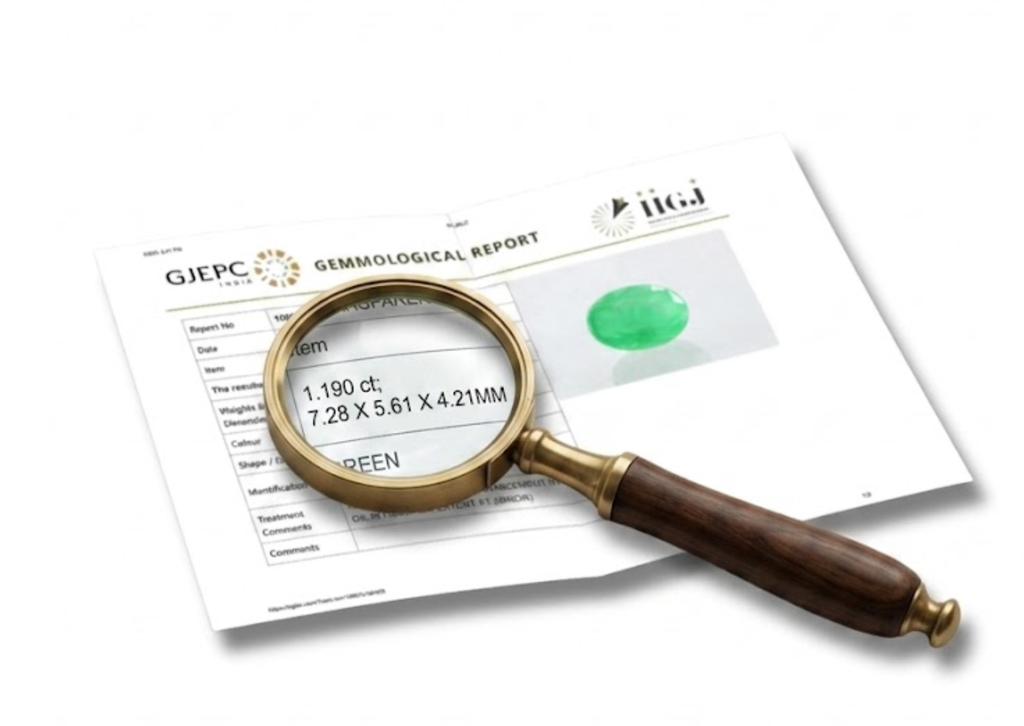
A valid lab report acts as the gemstone’s passport. Always check the online digital verification portal of the respective lab using the certificate number to confirm these exact details:
-
Species and Variety: (e.g., Natural Corundum -> Blue Sapphire)
-
Weight: Measured precisely in Carats.
-
Dimensions & Cut: (e.g., Cushion cut, Oval cut, Princess cut)
-
Color Profile: Explicit description of the hue and saturation.
-
Origin: (e.g., Ceylon/Sri Lanka, Burma, Zambia) – highly critical as origin heavily impacts market value.
-
Treatment Status: Explicitly states if the stone is Unheated, Heated, Fracture-filled, or Glass-filled.
2. Understanding Treatment vs. Authenticity
A common misconception is that a "treated" gemstone is fake. This is not true. Many natural gemstones undergo traditional industry treatments to enhance their visual appeal. However, disclosure is everything, and it drastically alters the pricing.
Unheated & Untreated Gemstones
These are exactly as nature created them, simply mined, cut, and polished. Because less than 1% of gem-quality stones are beautiful enough to skip treatments, unheated stones (especially Unheated Yellow Sapphires or Rubies) command massive price premiums.
Common Industry Treatments (Must Be Disclosed)
-
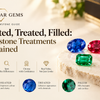
Heat Treatment: A widely accepted, permanent process using high temperatures to improve clarity and color saturation in sapphires and rubies.
-
Oil Treatment: Standard for Emeralds. Because natural emeralds inherently contain tiny fractures (referred to as jardin), colorless oils are used to improve clarity.
-
Banned/Low-Value Treatments: Avoid stones listed as Glass-filled, Diffused, or Fracture-filled if you are looking for an investment-grade or astrologically potent stone. These treatments artificially inflate appearance but ruin the stone’s intrinsic value.
3. The 4 Cs of Colored Gemstones
While the 4 Cs were popularized by diamonds, evaluating colored gemstones requires a slightly different approach, where Color is King.
[ COLOR ] -----> Primary Hue, Tone, and Saturation
   |
[ CLARITY ] ----> Flawless is rare; "Inclusions" prove natural origin
   |
[ CUT ] --------> Maximizes brilliance and retains carat weight (Oval, Cushion, etc.)
   |
[ CARAT ] ------> Weight of the stone (Price scales exponentially with size)
Color
Color is broken down into Hue (the actual color), Tone (how light or dark it is), and Saturation (the vividness or purity of the color). High-value gemstones feature vivid saturation without becoming overly dark or opaque.
Clarity
Unlike diamonds, colored gemstones are almost never completely flawless. Fine internal lines, microscopic crystals, and growth tracks are known as inclusions. In fact, completely flawless colored stones at cheap prices are a massive red flag for synthetic or lab-grown imitations.
Cut
A masterfully executed cut (such as a beautifully proportioned Oval cut or a symmetrical Cushion cut) isn't just about shape. It dictates how light dances through the stone. Look for high-clarity photography or video to ensure the stone doesn't have a "window"—a leaky, dead spot in the center where light passes straight through instead of reflecting back to your eye.
Carat Weight
Gemstone prices do not scale linearly. A single 3-carat premium Yellow Sapphire will cost significantly more than three individual 1-carat stones of identical quality, due to the sheer rarity of larger rough crystals in nature.
4. How to Spot Red Flags When Shopping Online
The digital jewelry market offers incredible variety, but it also requires a sharp eye. Protect your investment by avoiding storefronts that exhibit these warning signs:
-
"Too Good to Be True" Pricing: If an unheated, vivid blue 4-carat sapphire is listed for a fraction of the market rate, it is highly likely synthetic, glass-filled, or a simulated imitation.
-
Stock Photography Only: Authentic gemstone dealers showcase the exact stone you are buying. Look for high-definition, multi-angle imagery (side view, back view, top view) set against clean, professional backgrounds that show soft reflections and actual stone texture, rather than generic 3D digital renders.
-
Ambiguous Terminology: Watch out for deceptive phrasing like "Lab-Created Natural Sapphire," "Hydrothermal Emerald," or "Chatham Sapphire." These are sophisticated terms for synthetic, factory-grown stones.
5. The Online Gemstone Checklist for Buyers
Before completing your transaction, make sure the online boutique ticks every box on this security checklist:
| Buyer's Checklist Requirement | Why It Matters |
| Verifiable Lab Certificate | Ensures the stone's physical properties match its description from an unbiased third-party perspective (e.g., IGI , IIGJ). |
| HD Video & 360° Views | Allows you to inspect the stone's inclusions, cut symmetry, and color play under shifting light. |
| Secure Return Policy | A minimum 7-to-14 day, no-questions-asked return window is mandatory so you can verify the stone in person. |
| Insured Shipping | High-value loose gemstones must be shipped via secure, fully insured logistics partners with signature-required delivery. |
“At Tushar Gems, we provide 100% certified, astrologer-approved gemstones with 28+ years of trust — so you never risk wearing the wrong stone.”