Standard Cultured vs. South Sea – Which Should You Own?
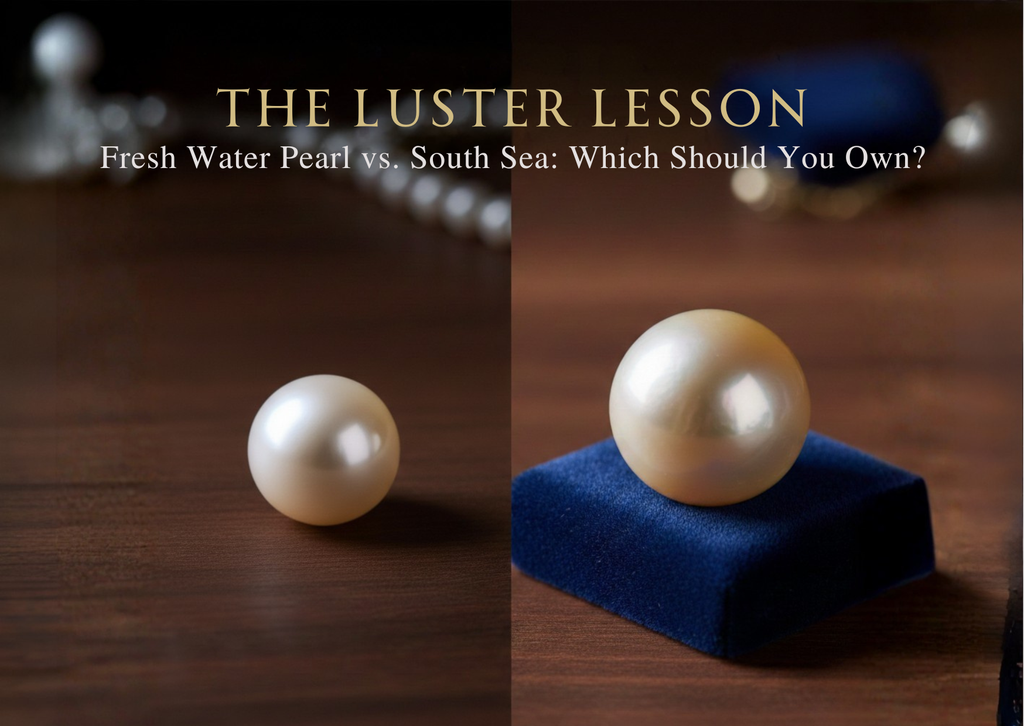
Pearls have long been symbols of "quiet luxury," but not all pearls are created equal. If you’ve ever browsed a jewelry store and wondered why one strand of white pearls costs $300 while another—seemingly identical—costs $10,000, you’ve bumped into the great divide: Standard Cultured (Akoya/Freshwater) vs. The South Sea Giant.
While technically both are "cultured" (meaning they are farm-raised rather than found by chance in the wild), the similarities end there. Here is the ultimate breakdown of the world’s most coveted gems.
1. The Origin Story: Nature’s Laboratory
To understand the price, you have to understand the "mother."
-
Standard Cultured (The Akoya & Freshwater): Most "classic" pearls come from the Akoya oyster or Freshwater mussels. These are the workhorses of the jewelry world. They are smaller, grow relatively quickly (6 to 24 months), and one mollusk can often produce multiple pearls at once.
-
South Sea (The Pinctada Maxima): These pearls are born from the silver-lipped or gold-lipped Pinctada maxima oyster. This oyster is the "diva" of the ocean. It is massive (the size of a dinner plate), extremely sensitive to pollution, and lives only in the deep, warm waters of the South Seas (Australia, Indonesia, and the Philippines).
2. The Luster: Mirror vs. Glow
Luster is the way light reflects off the surface. This is the most visual difference between the two.
-
The "Mirror" Shine (Akoya): Standard cultured pearls, specifically Akoyas, are known for a sharp, metallic luster. When you look at them, you can almost see your own reflection. It’s a bright, "hard" shine that pops against a dark dress.
-
The "Satin" Glow (South Sea): South Sea pearls have a soft, deep, "inner" glow. Because the nacre (the pearl material) is so thick, the light travels deep into the pearl before reflecting back. It looks like the pearl is lit from within by a candle, rather than being hit by a flashlight.
3. Size and Presence: The "Power" Factor
Size is the most obvious differentiator.
-
Cultured: Usually range from 3mm to 9mm. A 10mm Akoya is considered "massive" and very rare.
-
South Sea: They start at 8mm to 9mm and can go up to a staggering 20mm.
Pro Tip: If you see a pearl the size of a marble, it is almost certainly a South Sea pearl. Wearing a 15mm South Sea pearl isn't just wearing jewelry; it’s a power move.
4. The Nacre Factor: Why South Sea Pearls Last Generations
Nacre is the crystalline substance the oyster secretes to form the pearl.
In a standard Akoya pearl, the "seed" (bead) is large and the oyster only has a short time to coat it. This results in a thin layer of nacre. Over decades, this layer can wear thin or "blink" (show the bead underneath).
South Sea pearls are different. They stay in the water for 2 to 4 years. The result is a nacre layer that is incredibly thick (usually 2mm to 6mm thick). This makes them much more durable and gives them that legendary "deep" look that doesn't fade over time.
5. Investment & Value: The Price of Patience
Why do South Sea pearls cost a fortune? It’s a gamble of time and nature.
-
High Mortality: The oysters are hard to keep alive.
-
One-at-a-time: While a Freshwater mussel can produce 30 pearls at once, a South Sea oyster produces one.
-
Labor: Divers must hand-clean the oysters every few weeks to ensure they stay healthy in the wild.
| Feature | Akoya/Freshwater | South Sea |
| Best For | Daily wear, bridesmaids, office | Black-tie, heirlooms, investment |
| Durability | Moderate (avoid perfumes!) | High (thick nacre) |
| Colors | White, Pink, Lavender | Silver-White, Cream, Deep Gold |
Final Verdict: Which is right for you?
If you are looking for your first pair of pearls or a gift for a graduation, standard cultured pearls (like Akoyas) offer that iconic "Breakfast at Tiffany's" look without the mortgage-sized price tag.
However, if you are looking for an heirloom piece that feels substantial, rare, and commands attention from across a room, the South Sea pearl is the gold standard. It’s not just jewelry; it’s a piece of the ocean’s soul.