Natural Ruby and Lab-Grown Ruby: Differences
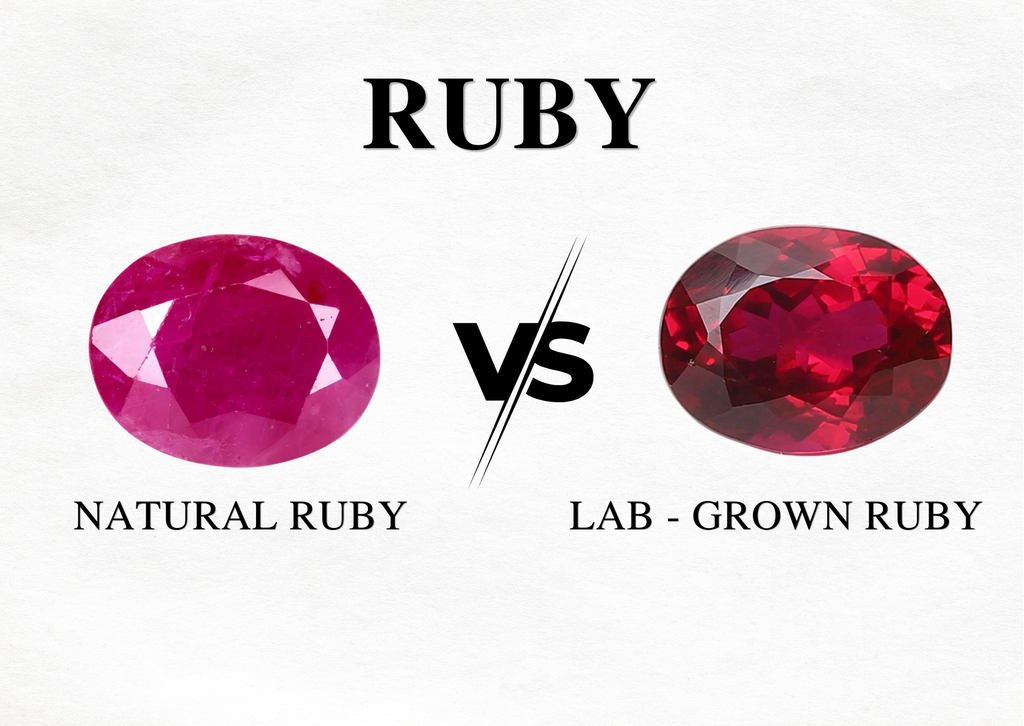
Natural Ruby vs. Lab-Grown Ruby: The Ultimate Guide to Choosing Your Red Gemstone
When it comes to the "King of Gemstones," the Ruby stands unparalleled. Its deep, fiery red hue has symbolized passion, power, and protection for centuries. However, modern technology has introduced a choice that often leaves buyers confused: Natural Rubies vs. Lab-Grown Rubies.
While they may look identical to the untrained eye, their origins, value, and stories are worlds apart. This comprehensive guide will help you understand the key differences, the science behind them, and how to make an informed investment.
Understanding the Basics: What Defines a Ruby?
Both natural and lab-grown rubies are made of Corundum, a mineral composed of aluminum oxide. The iconic red color comes from the presence of chromium.
-
Natural Ruby: Formed deep within the Earth's crust over millions of years under intense heat and pressure.
-
Lab-Grown Ruby: Created in a controlled laboratory environment using advanced technology that mimics the Earth’s natural processes but in a fraction of the time (weeks instead of millennia).
The 5 Key Differences Between Natural and Lab-Grown Rubies
| Feature | Natural Ruby | Lab-Grown (Synthetic) Ruby |
| Origin | Earth’s crust (Mined) | High-tech Laboratory |
| Inclusions | Natural "silk," fingerprints, and minerals | Very few to no eye-visible inclusions |
| Price | Premium/High Investment Value | Affordable/Budget-Friendly |
| Rarity | Extremely rare (especially unheated) | Mass-producible |
| Chemical Structure | Identical ($Al_2O_3$) | Identical ($Al_2O_3$) |
1. The Power of Inclusions (The "Birthmarks")
In the world of gemstones, perfection is often a sign of human intervention.
-
Natural Rubies almost always have "inclusions"—tiny needles of rutile (known as "silk"), small crystals, or liquid feathers. These are the gemstone's fingerprints and prove its organic origin.
-
Lab-Grown Rubies are often "too perfect." While they are chemically identical, they lack the unique internal world of a natural stone. If a ruby is large, vivid red, and completely eye-clean at a low price, it is almost certainly lab-grown.
2. Value and Investment Potential
If you are looking for a gemstone that holds its value or appreciates over time, Natural Rubies are the clear winner. High-quality natural rubies, especially those from Myanmar (Burma) or Mozambique, are becoming increasingly scarce.
Lab-grown rubies, while beautiful, have little to no resale value. They are considered "fashion" or "lifestyle" jewelry rather than an asset.
3. Ethical and Environmental Impact
-
Lab-Grown: Often marketed as the "eco-friendly" choice because they require no mining. However, the laboratories require significant energy to maintain the high temperatures needed for growth.
-
Natural: Mining has a larger physical footprint, but many modern mines support local economies and follow ethical "Fair Trade" practices. Always look for reputable sellers who provide certification.
4. Color and Clarity
Lab-grown stones usually feature the "ideal" pigeon-blood red color. Achieving this same vivid saturation in a natural stone is incredibly rare and comes with a significant price tag. For those who prioritize a flawless look on a budget, lab-grown offers a stunning aesthetic.
How to Tell the Difference?
While the chemical properties are the same, a professional gemologist can distinguish them using:
-
Microscopic Examination: Looking for curved growth lines (common in lab-grown) vs. angular growth lines (natural).
-
UV Fluorescence: Synthetic rubies often glow more intensely under UV light than many natural stones.
-
Certification: Always demand a certificate from a recognized lab (like GIA, IGI, or GRS). A certificate will explicitly state if the stone is "Natural" or "Synthetic/Lab-Grown."
Which One Should You Buy?
Choose a Natural Ruby if:
-
You want a unique piece of Earth’s history.
-
You are looking for an investment or an heirloom to pass down.
-
You appreciate the "perfect imperfections" of nature.
Choose a Lab-Grown Ruby if:
-
You want a large, vivid red stone at an affordable price.
-
You prefer a flawless, "clean" look.
-
You are looking for everyday jewelry that you don't have to worry about insuring.
1. What is a Natural Ruby?
A natural ruby is a miracle of nature. Formed over 20 million to 500 million years ago, these gemstones are created deep within the Earth’s crust. They are a variety of the mineral Corundum ($Al_2O_3$), gaining their legendary red color from the presence of chromium during their formation.
Because they are formed under extreme heat and tectonic pressure, they carry the "soul of the Earth" within them. No two natural rubies are ever exactly alike, making each stone a unique piece of history.
2. What is a Lab-Grown Ruby?
A lab-grown ruby (also known as a synthetic or created ruby) is chemically, physically, and optically identical to a natural ruby. It is not "fake" in the way glass or cubic zirconia is. Instead, it is "man-made."
Scientists use two primary methods to grow these stones:
-
Flame Fusion: A fast, affordable way to create ruby crystals.
-
Flux Growth: A slower, more expensive process that more closely mimics the natural environment, resulting in stones that are very difficult to distinguish from natural ones.
Visual Appearance and Clarity
In nature, perfection is rare. Natural Rubies almost always contain "inclusions"—tiny needles of rutile (known as "silk"), fingerprints, or small mineral crystals trapped inside. These are not flaws; they are proof of origin and authenticity.
Lab-Grown Rubies, on the other hand, are often "too perfect." They are usually eye-clean with no visible inclusions and possess a vivid, uniform red color. While beautiful, they lack the unique internal "garden" that gem enthusiasts often look for in a natural stone.
The Price and Rarity Factor
Rarity is what drives the price of a gemstone.
-
Natural Rubies: High-quality, unheated natural rubies (especially those over 2 carats) are incredibly rare. Their price reflects this scarcity, often reaching thousands of dollars per carat.
-
Lab-Grown Rubies: Because they can be mass-produced in a laboratory, they are significantly more affordable. You can often purchase a 2-carat lab ruby for a fraction of the cost of a 0.5-carat natural ruby.
Investment and Resale Value
This is perhaps the most important distinction for buyers.
-
Natural Rubies are considered an asset. High-grade natural rubies have historically appreciated in value, making them excellent heirlooms and investments.
-
Lab-Grown Rubies have virtually no resale value. Once you leave the showroom, the market value drops significantly because more can always be produced in a lab.
4. How to Identify Them: The Gemologist’s Secret
While they look the same to a casual observer, professionals use specific tools to tell them apart:
-
Microscopic Inspection: Natural rubies show angular growth lines, while lab stones (specifically flame-fusion) show curved striae.
-
UV Light: Synthetic rubies often show a much stronger, almost "neon" fluorescence under UV light compared to many natural stones.
-
Lab Reports: The only 100% certain way to know is a certificate from a reputable laboratory like GIA, IGI, or GRS , IIGJ .
5. Ethical and Environmental Considerations
-
Ethical Sourcing: Many buyers prefer lab-grown rubies because they are guaranteed to be "conflict-free" and do not involve mining.
-
Traditional Value: Conversely, the natural ruby industry supports the livelihoods of millions of artisanal miners and local communities in regions like Mozambique, Myanmar, and Madagascar.
6. Final Verdict: Which Should You Buy?
| Choose a Natural Ruby if... | Choose a Lab-Grown Ruby if... |
| You want an investment-grade gemstone. | You are on a strict budget but want a "big" look. |
| You value rarity and Earth-mined history. | You want a flawless, vivid red appearance. |
| You are looking for a timeless family heirloom. | You want an ethical, man-made alternative for daily wear. |
“At Tushar Gems, we provide 100% certified, astrologer-approved gemstones with 28+ years of trust — so you never risk wearing the wrong stone.”