How To Test Ruby Stone Purity at Home
Before diving into the tests, it is essential to understand what commonly passes for a natural ruby in today's market. Fake rubies generally fall into three distinct categories:
-
Imitations (Simulants): These are completely different materials made to look like ruby. Common examples include red glass, plastic, cubic zirconia (CZ), or cheaper natural red stones like red garnet and spinel.
-
Synthetic Rubies: These are chemically identical to natural rubies (both are made of corundum, or aluminum oxide) but are grown rapidly in a laboratory. Because they share the same physical properties, they can easily fool basic tests.
-
Composite or Glass-Filled Rubies: These are low-grade, highly fractured natural rubies that have been injected with high-lead red glass to improve their clarity and weight. They are heavily altered and carry significantly lower market value.
5 Simple Methods to Test Ruby Purity at Home
Here is a step-by-step breakdown of the most effective DIY tests you can conduct safely at home to check the quality and purity of your ruby.
1. The Visual Scratch Test (Hardness Check)
The physical properties of a gemstone provide excellent clues regarding its authenticity. Ruby is an exceptionally hard mineral. On the Mohs hardness scale, a natural ruby scores a 9 out of 10, sitting just below diamond, which scores a perfect 10.
2. The Flaw and Inclusion Inspection
In nature, perfection is incredibly rare. As natural rubies form deep within the Earth's crust over millions of years under extreme heat and pressure, they absorb microscopic structural imperfections. These are known as inclusions.
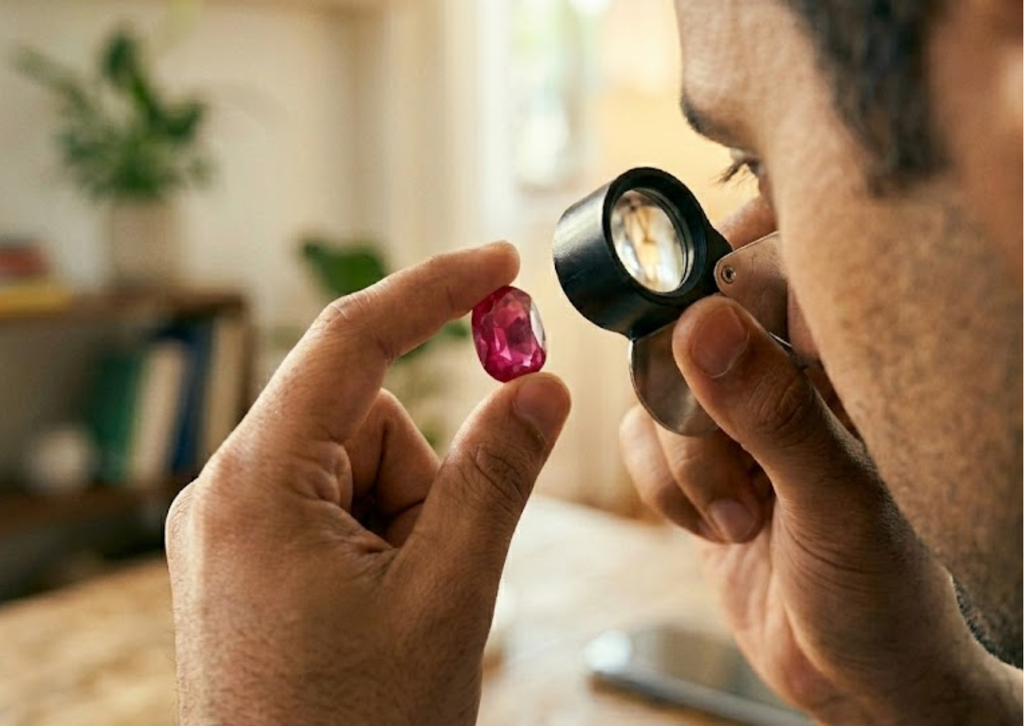
To perform this test, you will need a 10x jeweler’s loupe or a high-powered magnifying glass under strong, direct lighting.
-
What to look for: Look closely at the interior of the stone. Natural rubies typically display unique internal features such as tiny mineral crystals, jagged liquid veining, or "silk" (fine, needle-like intersecting lines of rutile).
-
The Red Flags: If the interior of the stone looks absolutely flawless, clear as water, and lacks any inclusions whatsoever, it is highly likely a synthetic laboratory-grown ruby or a piece of glass. Furthermore, if you spot perfectly round, microscopic air bubbles, the stone is definitively glass. Natural geological formations do not trap round air bubbles.
3. The Streak Test (Color Transfer Check)
Many cheap fake stones are simply clear crystals or glass blocks that have been externally dyed with red pigments to mimic the appearance of a premium gemstone.
-
How to do it: Locate a piece of unglazed white porcelain tile (such as the unpolished back of a ceramic kitchen or bathroom tile). Hold your ruby firmly and draw it firmly across the porcelain surface.
-
The Verdict: A pure, genuine ruby will not leave a red streak behind. Because the red color is bound into its chemical crystal lattice, it cannot rub off. If a noticeable red trail or crayon-like smudge is left on the white porcelain, the stone has been artificially dyed and is a counterfeit.
4. The Breath Test (Thermal Conductivity)
Because natural corundum conducts heat very efficiently, it disperses moisture across its surface far faster than glass or plastic.
-
How to do it: Clean the ruby thoroughly with a microfiber cloth to remove oils. Hold the stone close to your mouth and exhale deeply onto it, clouding it up with your breath just like you would fog a mirror.
-
The Verdict: Count the seconds it takes for the fog to completely clear from the gemstone's surface. On a genuine natural ruby, the fog should vanish almost instantly—typically within 1 to 2 seconds. If the gemstone stays foggy or holds moisture for 5 seconds or longer, it is likely a glass imitation.
5. The True Color and Brilliance Test
Natural rubies possess a distinct, deep, and rich hue often referred to as "pigeon's blood red." While they are exceptionally bright, they do not refract light in the same manner as diamonds or certain synthetic simulants.
-
The Check: Place the stone under a bright, neutral desk lamp. Look at the flashes of light reflecting off the facets.
-
The Verdict: A true ruby glows with a vivid, deep red color. If the stone reflects flashes of multiple secondary rainbow colors (such as bright greens, blues, or yellows), it is likely a highly refractive imitation material like synthetic cubic zirconia or glass.
Summary Comparison: Real Ruby vs. Counterfeits
| Characteristic | Natural Pure Ruby | Synthetic Ruby | Red Glass / Imitation |
| Hardness (Mohs Scale) | 9 (Extremely hard, scratches glass) | 9 (Extremely hard) | 5.5 to 6 (Easily scratched by steel) |
| Internal Features | Natural silk, mineral crystals | Flawless or curved growth lines | Microscopic round air bubbles |
| Breath Fog Clears | Instantly (1-2 seconds) | Instantly (1-2 seconds) | Slowly (5+ seconds) |
| Porcelain Streak | None (Clear) | None (Clear) | Leaves a red color trail (if dyed) |
When to Seek Professional Gemological Certification
While home testing is an excellent first step for filtering out cheap glass imitations and dyed stones, it has definitive limitations. For example, a synthetic lab-grown ruby will pass the scratch test, the streak test, and the breath test perfectly because it shares the exact same chemical blueprint as a mined stone.
Crucial Rule: If you are planning an expensive gemstone purchase, or if your home tests indicate a stone might be genuine, always request a certificate from an accredited, independent laboratory (such as IIGJ, IGI , or GJEPC). Only a certified gemologist using specialized tools can conclusively differentiate a natural, unheated ruby from a high-tech synthetic variant or a lead-glass filled composite.
“At Tushar Gems, we provide 100% certified, astrologer-approved gemstones with 28+ years of trust — so you never risk wearing the wrong stone.”