Australian Opal vs Ethiopian Opal: Which Is Better?
Opals are undoubtedly among the most mesmerizing gemstones in the world, renowned for their shifting play-of-color that mimics galaxies trapped in glass. However, when you step into the market to buy a natural opal stone, you will immediately face a classic debate: Australian Opal vs Ethiopian Opal.
Whether you are buying a gemstone for its mystical astrological benefits of Venus (Shukra) or looking to design high-end, luxury jewelry, choosing the right origin is critical. While one offers timeless stability and unmatched heritage, the other presents a brilliant, fiery glow at a highly accessible price point.
In this comprehensive, deep-dive guide, we will break down the structural, visual, financial, and astrological differences between Australian and Ethiopian opals so you can confidently decide which one is better for your specific needs.
Direct Comparison at a Glance
| Feature | Australian Opal | Ethiopian Opal (Welo Opal) |
| Geographical Origin | Australia (Lightning Ridge, Coober Pedy) | Ethiopia (Wello Province) |
| Geological Formation | Sedimentary (Formed over millions of years) | Volcanic (Formed in volcanic basalt layers) |
| Structure & Nature | Non-porous, stable water content | Hydrophane (Porous, highly water-absorbent) |
| Durability & Daily Wear | High durability; highly resistant to cracking | Moderate durability; prone to clouding or cracking |
| Color & Fire Intensity | Deep, defined, lifetime permanent color play | Highly vibrant, translucent, neon-like fire |
| Astrological Impact | Strongest, stable, and lifelong results for Venus | Temporary or weaker long-term effects due to vulnerability |
| Price & Carat Value | Premium investment grade (Expensive) | Highly affordable and budget-friendly |
1. Geological Origin & Formation: Old vs New World
The fundamental differences between these two gemstones lie deep underground.
Australian Opal: The Sedimentary Legend
Australian opals are the undisputed kings of the traditional gem market, accounting for nearly 95% of historical precious opal supplies. These stones formed over 140 million years ago within sedimentary rock layers. As silica-rich water seeped into ancient desert cracks and dried out incredibly slowly, it left behind highly orderly, dense spheres of silica. This slow, steady formation gives Australian opals remarkable physical stability.
Ethiopian Opal: The Volcanic Rising Star
Discovered relatively recently (gaining major commercial traction around 2008 in the Wello Province), Ethiopian opals are formed through volcanic processes. High-temperature, silica-rich fluids filter through cracks in volcanic basalt. This rapid, volcanic birth results in a chemically distinct structure that gives them a glassy, highly transparent appearance.
2. The Hydrophane Factor: How They Handle Water
This is the single most critical technical difference that every jewelry designer and gemstone buyer must understand.
Ethiopian Opals are "Hydrophane"
The word hydrophane stems from Greek, meaning "water-loving." Ethiopian Welo opals are highly porous and act like a literal sponge. When submerged in water, an Ethiopian opal will absorb the moisture, completely changing its transparency and temporarily losing its play-of-color.
[Dry Ethiopian Opal: Vibrant Fire] ➔ [Exposed to Water/Oils] ➔ [Absorbs Liquid: Becomes Opaque/Brown]
While it usually returns to its original state after drying out naturally over days, prolonged exposure to tap water, soaps, body oils, perfumes, or sweat can permanently ruin the stone, turning it cloudy, yellow, or brown, and killing its internal fire forever.
Australian Opals are Stable
Australian opals naturally contain a fixed internal water percentage (typically 3% to 10%) tightly locked within their non-porous structure. They are non-hydrophane. This means putting an Australian opal in water, washing your hands with it, or accidentally getting lotion on it will not alter its appearance or compromise its structural integrity. Its fire is locked in for a lifetime.
3. Durability & Suitability for Daily Wear
If you are planning to set your gemstone into a frequently worn ring or a daily-wear pendant, durability matters immensely. Opals, in general, are delicate stones (measuring 5.5 to 6.5 on the Mohs hardness scale), but origin heavily tilts the scale.
-
Australian Opal: Because of their dense, sedimentary formation, they are highly stable. They are not prone to "crazing" (developing spider-web-like surface cracks due to atmospheric humidity changes). This makes them the ideal choice for everyday fine jewelry.
-
Ethiopian Opal: Because they swell when absorbing moisture and shrink when drying, the constant expansion and contraction puts massive stress on the stone. Over time, Ethiopian opals are highly susceptible to cracking, chipping, or becoming permanently dull if not handled with absolute, extreme care. They are best reserved for occasional wear or protective settings like earrings and brooches.
4. Visual Appeal: Fire, Transparency, and Base Tone
Both stones look vastly different when placed under high-key professional lighting.
Base Tones and Color Distribution
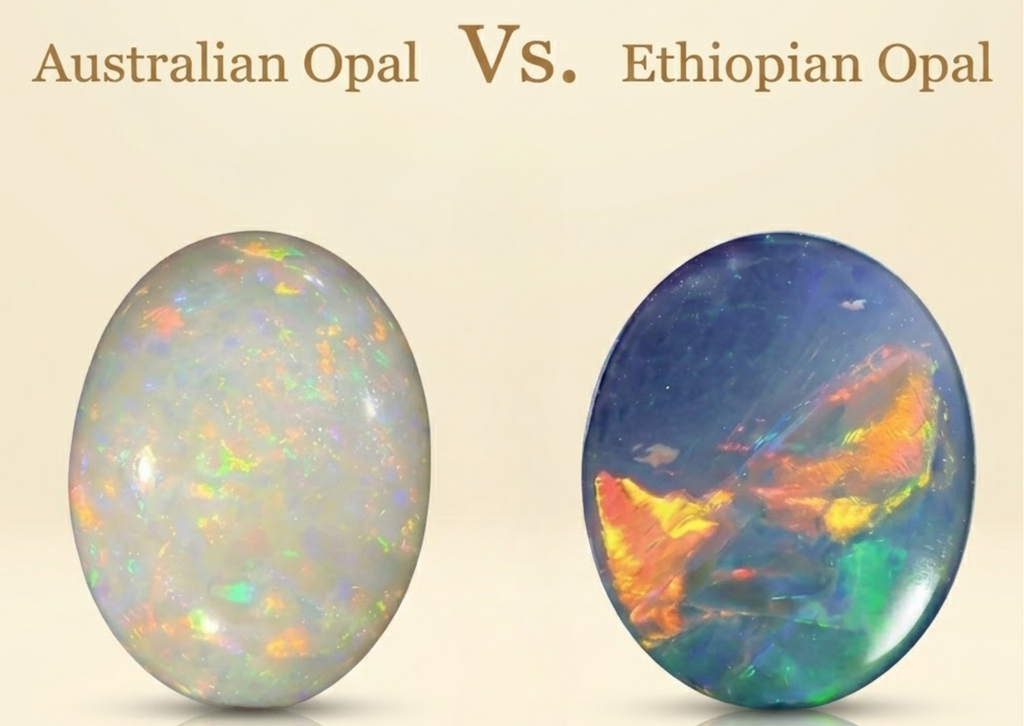
Australian opals are famous for their rich, solid base tones. They come in legendary varieties like Black Opal (from Lightning Ridge), White Opal, and Boulder Opal. The color play is highly defined, featuring distinct geometric patterns like harlequin, pinfire, or ribbon flashes against an opaque or semi-transparent background.
Conversely, Ethiopian opals are predominantly crystal or white opals. They display an intensely bright, 3D neon play-of-color that looks like it is floating inside a clear drop of water. Because they are highly translucent, light passes through them effortlessly, creating breathtaking, vivid flashes of red, orange, green, and neon blue that can look even brighter at first glance than standard Australian white opals.
5. Astrological Benefits for Planet Venus (Shukra)
In Vedic astrology, Opal (Dudhiya Patthar) represents the planet Venus (Shukra), which governs luxury, beauty, artistic talents, romance, and marital bliss.
Active Fire Flashes = Transmitting Astrological Rays to the Wearer
Astrologically, the continuous, uninterrupted radiance of the stone is what transmits positive cosmic energies to the wearer.
-
Why Astrologers Prefer Australian Opal: For genuine Vedic remediation, stability is paramount. An Australian opal maintains its intense fire consistently year after year, guaranteeing an uninterrupted flow of Venusian energies to boost your creativity, love life, and financial prosperity.
-
The Risk with Ethiopian Opal: Because an Ethiopian opal easily absorbs environmental oils, sweat, and dirt from the skin, it can quickly turn cloudy or yellow. Once the stone turns dull or its fire is compromised, it completely loses its astrological efficacy and can no longer channel the positive rays of Venus effectively.
6. Pricing, Carat Weight, and Investment Value
From a purely commercial perspective, the price dynamics of these two origins are worlds apart.
-
Australian Opal (The Premium Investment): Due to strict mining regulations in Australia, soaring extraction costs, and dwindling reserves, premium Australian opals command a hefty price tag. High-grade double-sided fire stones or rare black opals are highly prized by collectors, hold exceptional resale value, and are considered true luxury investments.
-
Ethiopian Opal (The Budget-Friendly Wonder): Ethiopian mines are highly productive, resulting in an abundant market supply. Because they are easier to mine and cut into large-carat cabochons, they are exceptionally wallet-friendly. You can purchase a visually massive, dazzlingly fiery Ethiopian opal for a small fraction of the cost of an equivalent Australian stone.
Final Verdict: Which One Is Better for You?
Buy an Australian Opal if:
-
You are purchasing the gemstone primarily for astrological benefits to appease planet Venus.
-
You intend to set it in an engagement ring, daily-wear ring, or pendant that will face everyday handling.
-
You are looking for a rare heirloom piece with high resale and investment value.
-
You want a stone that requires low maintenance and will look exactly the same decades from now.
Buy an Ethiopian Opal if:
-
You are working with a strict budget but still want an incredibly flashy, head-turning stone with jaw-dropping neon fire.
-
The jewelry piece is meant for occasional, casual, or statement wear (like high-fashion earrings or cocktail rings) rather than daily use.
-
You love the glassy, clear, translucent aesthetic of crystal opals and are willing to take meticulous care to keep it dry and away from chemicals.
“At Tushar Gems, we provide 100% certified, astrologer-approved gemstones with 28+ years of trust — so you never risk wearing the wrong stone.”